三陸復興 | Sanriku Fukkou

Deutsch-Japanisches Synergie Forum (DJSF) Sanriku Fukkou e.V.

三陸復興 | Sanriku Fukkou

震災後整備の防潮堤 4割が計画と「ずれ」

9月25日 7時29分
震災後整備の防潮堤 4割が計画と「ずれ」

東日本大震災のあと宮城県の漁村に整備される防潮堤のうち、津波から守るとされた集落が存在しないなど、当初の計画と異なるまま整備が進められているケースが全体の4割に上ることが、NHKの取材で分かりました。専門家は「将来の維持費などを考慮して整備計画を精査すべき時期にきている」と指摘しています。
東日本大震災の被災地では、数十年から百数十年に1度起きる可能性のある津波から人命や住宅などを守る目的で、各地で防潮堤の整備が進められていて、およそ9000億円の予算が投じられる計画です。
NHKは、このうち先月宮城県が公表した防潮堤計画のうち、市や町が漁村に整備する101地区について自治体などに取材しました。
その結果、当初の計画で集落を守るとされている防潮堤は合わせて67ありましたが、現在では防潮堤の背後に家屋や集落が存在していない地区が37あることが分かりました。
さらに、復旧する水産施設を守るとして計画された防潮堤25のうち4つの地区では復旧の見込みが立たないなど、当初の計画とは異なるまま整備が進められているケースが全体の4割に上っています。
計画の多くは国の方針に沿って震災直後に復旧や整備が決まりましたが、被災地の多くの漁村ではその後、人口流出が進んでいます。
防潮堤の問題に詳しい東北大学の平野勝也准教授は「人口が減少するなかで何でも守るのが本当によいのか、将来の維持費の負担も考慮して整備計画を精査すべき時期にきている」と指摘しています。

被災地の海岸線、姿現す防潮堤 巨大さに戸惑いの声も

Nach Angaben des Ministeriums werden in  594 Orten in Fukushima, Miyagi und Iwate Ufermauer  geplant. Bei 30% von ihnen, an etwa 180 Standorten, werden nach Befragungen der Bürger, die Höhe und Position der Mauern überprüft.

被災地の海岸線、姿現す防潮堤 巨大さに戸惑いの声も

朝日新聞デジタル 9月20日(日)19時39分配信

 太平洋を望む東北の海岸線で、防潮堤の建設が進んでいる。国土交通省によると、岩手、宮城、福島の3県で総延長約400キロ、総工費は1兆円ほど。津波への備えとはいえ、徐々に姿を現す巨大なコンクリートの壁に、住民からは戸惑いの声も上がる。

【写真】宮城県気仙沼市唐桑町の海岸に建設中の防潮堤は傾斜型。高さ・幅とも震災前の大きさから拡充された=福留庸友撮影

防潮堤の高さは、理論的にはじき出された。数十年から百数十年おきに起こる大津波の高さを、過去にその地域を襲った津波を参考に予測。津波のせり上がりを考慮して1メートル分高く設計された。

ただ、防災の観点で理論的にはじき出した高さに、住民がすべて納得しているわけではない。

宮城県南三陸町寄木(よりき)地区の高橋七男区長は「壁をそこまで高くしなくても、命を守る避難路と避難場所の整備で十分」と語る。「海辺に住んでいる人間は津波を覚悟している。多少の被害があっても、海の見える風景と、その恵みを受ける暮らしを孫に残したい」

今回の取材で、宮城県や岩手県の防潮堤の建設現場をいくつも訪れた。住民からは「海がまったく見えない」「高台移転するのに何を守るのか」「そこまでの巨費を投じるなら、ほかの復興事業にお金を回した方がいいのでは」といった不安や疑問の声を聞いた。

国交省によると、3県で防潮堤が計画されているのは594カ所。そのうちの3割、約180カ所で、住民の声を受け、高さや位置の見直しが行われた。地元と合意していないのは5%の28カ所だという(6月末現在)。(福留庸友)

JapanVor Schlimmerem bewahrt

16. September 2015, 19:01 Uhr

To match Interview JAPAN-KAN/

Naoto Kan, 69, war von2010 bis 2011 Japans Regierungschef. Mehrmals war er Vorsitzender der Demokratischen Partei. Kan ist studierter Physiker.

(Foto: Yuriko Nakao/Reuters)

Der frühere japanische Premier Naoto Kan blickt zurück auf die Katastrophe von Fukushima: In seinem Buch beschreibt er, was alles schieflief in den Tagen nach dem Reaktor-Unglück.

Von Christoph Neidhart, Tokio

Eigentlich sei Naoto Kan an der Atomkatastrophe von Fukushima schuld, hat der bekannte Japanologe Jeff Kingston einmal die Anschuldigungen der Medien und vieler konservativer Politiker gegen den ehemaligen Premier zusammengefasst. Doch Kingston, Direktor des Asien-Instituts an der Temple Universität, der selbst eine Studie über Fukushima verfasst hat, ist überzeugt: Kan habe Japan vor einer viel größeren Katastrophe bewahrt. Wie er das tat, lässt sich jetzt in Kans Buch „Als Premierminister während der Fukushima-Krise“ nachlesen, das nun auf Deutsch erschienen ist. Am Mittwoch stellte der 69-Jährige es vor der Ostasiengesellschaft in Tokio vor. An der Wand hinter ihm hing eine Karte von Ost-Japan mit konzentrischen Kreisen um den Havarie-Reaktor: das „Worst-Case“-Szenario.

Ausgearbeitet hatte es der Vorsitzende der Atomenergie-Kommission, Shunsuke Kono, während der ersten Wochen der Katastrophe. Der äußerste Kreis, 250-Kilometer vom Kraftwerk entfernt, schließt Tokio mit ein. Im schlimmsten Fall hätte der ganze Umkreis evakuiert werden müssen. „50Millionen Menschen, und nicht für einige Tage oder Monate, sondern vielleicht für 30 oder 40 Jahre“, sagt Kan. Außerdem hätte Fukushima die Nachbarländer radioaktiv verseucht.

Die japanische Presse wusste von diesem Szenario zunächst nichts, später verschwieg sie es. Und verbreitete stattdessen Lügen über Kan, der als ehemaliger Umweltaktivist vom politischen Establishment nie akzeptiert worden ist. Die Medien warfen ihm vor, er habe die Katastrophe verschlimmert, etwa mit seinem Inspektionsbesuch am Morgen nach dem Unglück. Überdies habe er die Meerwasserkühlung der durchschmelzenden Reaktoren gestoppt. Beides stimmt nach offiziellen Untersuchungen nicht. Die Behauptung, Kan habe die Meerwasserkühlung gestoppt, hat der jetzige Premier Shinzo Abe in die Welt gesetzt, ein Mann der Atomlobby. Kan hat ihn wegen Verleumdung verklagt. Das Urteil wird in diesem Jahr erwartet.

Tepco hatte sich nicht auf einen Notfall vorbereitet. Als er eintrat, wusste niemand, was zu tun war

Kan sagt von sich, bis Fukushima habe er nicht an der Sicherheit der japanischen Kernkraftwerke gezweifelt. Er kannte die Untersuchungsberichte von Tschernobyl und war überzeugt, dergleichen sei in Japan nicht möglich. Heute hält er Fukushima für die größere Katastrophe als Tschernobyl. Die Tage unmittelbar nach dem Unglück, in denen fast alles falsch lief, was falsch laufen konnte, haben ihn, wie er in seinem Buch beschreibt, zum Kernkraft-Gegner werden lassen. Er schildert, wie die Tepco-Bosse in Tokio am vierten Tag nach dem Tsunami die havarierten Reaktoren hatten aufgeben wollen. Sein tagebuchartige Rückblick liest sich als Beinahe-Untergang Japans. Tepco hatte sich nie auf eine Atomkatastrophe vorbereitet, man hatte sie ja schließlich für unmöglich erklärt. Niemand hatte den Notfall geprobt. Als er doch eintrat, wusste niemand, was zu tun war. Stecker passten nicht, und als die Feuerwehr aus Tokio Spezialfahrzeuge an den Rand der Sperrzone brachte, holte Tepco sie nicht ab. Die Tepco-Bosse in der Hauptstadt konnten selbst einfache Fragen nicht beantworten, der Chef der nuklearen Aufsichtsbehörde hatte keine Ahnung von Atomtechnik – er war Ökonom. Haruki Madarame, verantwortlich für Nuklearsicherheit, behauptete gegenüber dem Physiker Kan, eine Wasserstoff-Explosion am havarierten AKW sei nicht möglich. Kurz darauf ereignete sich die erste von dreien.

Er glaube, Gott habe Japan gerettet, sagt Kan. Als der Sicherheitsbehälter von Reaktor 2 wie ein Ballon zu platzen und sich die Radioaktivität weit zu verstreuen drohte, weil es nicht gelang, ein Sicherheitsventil zu öffnen, bildete sich irgendwo ein Loch. Wie ein Wunder fiel der Druck ab, warum, weiß bis heute niemand. Die Brennstäbe im Abklingbecken 4 hätten bald ohne Wasserkühlung unter freiem Himmel gelegen und zu schmelzen begonnen, hätte sich in der Trennwand zum Nebenbecken nicht ein Loch aufgetan, sodass Wasser einfließen konnte. Dabei hätte das Nebenbecken nach Plan leer sein sollen.

Nachdem Kan zum Kernkraft-Gegner bekehrt war und die Abschaltung des AKW Hamaoka westlich von Tokio durchsetzte, betrieb die Atomlobby mit Unterstützung Shinzo Abes im September 2011 seinen Rücktritt. Bis heute verweigert Japan seinem früheren Premier die Achtung und den Dank, die ihm gebühren. Naoto Kans Buch ist emotional, zuweilen etwas sprunghaft, wie angeblich auch sein Führungsstil. Im Vortrag in Tokio dagegen überzeugte er seine Zuhörer mit klarer Argumentation gegen die Kernkraft. Die Welt dürfe keinen radioaktiven Abfall produzieren, der 100 000 Jahre überwacht werden müsse. Außerdem sei die Kernkraft nicht nur gefährlich, sondern inzwischen auch viel zu teuer.

Under radioactive shadow of Fukushima, town of Naraha tries to come back to life

/

BY

AP, SEP 9, 2015

A few signs of life are returning to this rural town made desolate by the Fukushima nuclear disaster 4½ years ago: Carpenters bang on houses, an occasional delivery truck drives by and a noodle shop has opened to serve employees who have returned to the small town hall in Naraha, Fukushima Prefecture.

But weeds cover the now rusty train tracks, there are no sounds of children and wild boars still roam around at night. On the outskirts of town, thousands of black industrial storage bags containing radiation-contaminated soil and debris stretch out across barren fields.

This past weekend, Naraha became the first of seven towns that had been entirely evacuated to reopen since the March 11, 2011, disaster, when tsunami slammed into the Fukushima No. 1 nuclear power plant, causing meltdowns and massive radiation leaks.

The town’s viability is far from certain, and its fate will be watched closely by authorities and neighboring towns to see if recovery is indeed possible on this once-abandoned land.

Just over a tenth of Naraha’s population of 7,400 say they plan to move back soon, and only a few hundred have actually returned, most of them senior citizens. Schools won’t reopen for another two years, and many families with children are staying away due to concerns about radiation levels, which authorities say are below the annual allowable limit. Residents are given personal dosimeters to check their own radiation levels if they want.

One thing that won’t change is the town’s dependence on the nuclear industry — only this time it will involve dismantling damaged reactors, not building and running them.

An economic revival plan centers on a giant ¥85 billion facility that is being built on the edge of town to research, develop and test specialized robots and other technology — part of the government’s “Innovation Coast” plan to turn the disaster-hit region into a hub for nuclear plant decommissioning technology.

The complex will include mock-ups of sections of the wrecked Fukushima reactors to train workers on robot operations. Dismantling the No. 1 plant and removing its melted reactor cores will take about 40 years, the government estimates.

The facility is expected to draw hundreds of workers, and the town also seeks to host laborers to decontaminate buildings and outdoor areas in the region. Naraha is also home to a second nuclear power plant — Fukushima No. 2 — that barely survived the tsunami but may be scrapped due to local opposition to its restart. So it may also be dismantled.

Returning residents are determined to make a go of it, but they wonder if the town will survive economically — and mourn that it will never be the same cozy place it was five years ago.

“There are more decontamination workers than townspeople. It’s like we’ve been taken over,” said carpenter Koichi Takeda, who evacuated to the nearby city of Iwaki and was in town to help a friend clean her house.

He has a number of clients renovating their houses in Naraha, but most of them are undecided about whether they will actually return. “It’s like keeping a vacation home here,” he said.

The southern edge of Naraha already hosts a soccer park called J-Village where temporary dormitories have been erected to house thousands of workers at the No. 1 plant. Some residents, especially women, say they feel intimidated by a growing number of male workers from outside the town, citing the recent arrest of a former decontamination worker in another town of Fukushima in a murder case.

“I’m more concerned about security in town rather than the shortage of groceries and other inconveniences,” said Yukiko Takano, 43, who runs a mobile cafe out of her van near the town hall.

Tokuo Hayakawa, a 75-year-old Buddhist monk who returned with his wife, said he wasn’t very optimistic about the town’s future.

“The town’s reconstruction plan seems to be mainly for people from outside,” he said. “If I were in my 20s or 30s, I wouldn’t have returned. But at my old age I don’t have time and energy to start over elsewhere.”

Other elderly residents said they felt sad about not being able to invite grandchildren anytime soon given radiation concerns for kids.

“I was so sad to hear that my daughter said she can’t bring her child here,” said Taeko Suzuki, 63, getting teary. “She grew up here and this is her home. We built this place for her to come back when she wants to.”

Some 100,000 people from about 10 municipalities around the wrecked nuclear plant still cannot go home. Many have moved to apartments or houses elsewhere, and some live in temporary housing built by the government.

The government hopes to lift all evacuation orders except for the most contaminated areas around the plant by March, 2017, offering up to ¥100,000 per household for moving back. But evacuees criticize the plan as a public relations stunt to showcase Fukushima’s recovery ahead of the Tokyo 2020 Games. Sections of two other towns reopened last year, but only half of their populations have since returned.

Naoko Kanai, a 50-year-old homemaker, is among those wrestling with whether to return to Naraha.

Kanai, who lost her job at a manufacturing company office in town that closed after the disaster, was back Saturday to check her house for the first time in about two months. Previously, she had said she had no intention of moving back as her family had resettled in nearby Iwaki.

But as she opened the living room curtains to let in the air, her emotions wavered.

“This is not just a house, it’s filled with memories of my family and its history,” Kanai said. “I remember how we talked about the design of this house, the color of the curtain when we first moved in. This is where I packed lunch for my boys.”

Her older son has since married and doesn’t want to come back with his baby. But her second son keeps his room almost the way it was in 2011 — his high school uniform hangs in the closet, a bookshelf filled with comic books, and a blanket folded on his bed.

“He wants to come back,” Kanai said. “I can’t abandon this place.”
Mayor links solar plant construction to floods

Mayor links solar plant construction to floods

Kyodo, AFP-JIJI, JIJI, Staff Report

The mayor of Bando has blamed a huge solar power plant project near the Kinugawa River for exacerbating the disastrous flooding in Joso, Ibaraki Prefecture, by shaving off the top of a natural sandbank that had effectively become part of its east bank.

The removal of the layer of sand lowered the height of the embankment, which is in the Wakamiyado district, Bando Mayor Eiichi Yoshihara indicated. Bando is situated next to Joso.

Yoshihara made the remark during a meeting Friday with the central government’s research group on the flooding disaster. He urged the government to give the voices of local residents greater consideration when giving the green light to construction projects.

“I’m speaking on behalf of Joso,” Yoshihara said while displaying before and after photos of the devastated area.

Minutes from a Joso Municipal Assembly meeting last year state that a portion of the embankment about 150 meters wide and 2 meters high had been scraped off the top for the solar power project.

According to the land ministry, the sand embankment, which is private property, formed over time from sand and gravel carried down the river. Residents say it served as a natural riverbank, as opposed to the man-made levees.

Feeling the embankment had been compromised, officials in the city of Joso made several requests to the land ministry asking it to build a formal levee. The embankment, about 5 km upstream from the spot where a levee collapsed Thursday, was overwhelmed by the swollen river, flooding communities alongside it.

In July 2014, in response to the levee requests, the ministry deposited giant sandbags at the embankment after getting permission from the landowner.

“(The government) has no responsibility over how private property is changed,” a ministry official said. “We cannot be sure that is what caused the flood.”

How high the embankment was originally and how high the sandbags were piled remains unclear.

“Local residents have cherished the sand embankment as a way to prevent flooding,” said a man, 47, who lives near the site. “Even if it’s private property, local tradition that the community has protected should be respected.”

Rescue operations continued Saturday for more than 100 people still stranded in Joso, and 15 people remained missing.

In Kurihara, Miyagi Prefecture, a body was found Saturday at a river, raising the death toll to four.

“I felt more dead than alive,” said a man who was rescued Saturday morning after spending days trapped in his home.

“I lived by drinking tea as there was no food. I’m so glad that they came to rescue me,” he told NHK.

As the water began to recede, police officers wearing life vests shoved poles into the thick mud to locate any victims.

“The city is completely destroyed — we need people’s help,” said Shinichi Ishizuka, 47.

On Saturday morning, Prime Minister Shinzo Abe visited the disaster-hit city some 60 km northeast of Tokyo, as some 2,000 troops, police and firefighters worked to rescue people trapped in water-logged buildings. Most were patients and hospital staff, local media reported.

“We’re doing our best to make things safe by reconstructing the broken (river) bank as quickly as possible to prevent a repeat of this disaster,” Abe told reporters.

As the skies cleared, water levels began to return to normal in the river after the heaviest rain in years pounded the country in the wake of Typhoon Etau.

“We are working hard to rescue people trapped in buildings and find those who still are unaccounted for, while pumping out water,” a local government official said. “But water levels are still high in many areas so that has hampered our operations.”

The number of missing in Joso declined from 22 to 15 after police found more victims alive, including a pair of 8-year-olds. It was not immediately clear where the children were found, but some of the missing appeared to have been among those trapped in flooded buildings.

People and houses were not the only ones swept away by the flood.

Bags filled with radiation-tainted grass and soil from cleanup work near the crippled Fukushima No. 1 nuclear plant were swept away in the flooding of rivers in Iitate, Fukushima Prefecture, the Environment Ministry said.

A total of 82 of the bags were discovered, with 37 of them recovered Friday, though it remained unclear how many had been washed away, the ministry said.

Japan floods: City of Joso hit by ‚unprecedented‘ rain

  • 10 September 2015
  • From the sectionAsia

Widespread flooding and landslides in north-east Japan have forced more than 90,000 people to abandon their homes.

The city of Joso, north of the capital, Tokyo, was hit by a wall of water after the Kinugawa River burst its banks. Helicopter rescue teams have been plucking people from rooftops.

At least eight people are still missing and 100 need rescuing.

The rains come a day after a tropical storm brought winds of up to 125km/h (78mph) to central Aichi prefecture.

The chief forecaster at the Japan Meteorological Agency (JMA), Takuya Deshimaru, said that the rainfall was „unprecedented“ for that part of Japan.

„We can say this is an abnormal situation and there is imminent serious danger,“ he went on.

Floodwater in Joso, JapanImage copyrightAP
Image captionThe Kinugawa River in Joso burst its bank on Thursday, flooding homes

Analysis by the BBC’s Mariko Oi in Japan

Japan gets hit by, on average, 20 to 30 such storms each year. This is the 18th this year so despite the heavy rainfall that we have experienced over the last few days, it was difficult to predict how severe the damage would be.

The Kinugawa River bursting its banks took even experts by surprise, especially because of the widespread areas that it has affected.

Just as in previous natural disasters, including the 2011 earthquake and tsunami, Japan’s non-combat military Self-Defence Force is playing a major role in the rescue operations and it is receiving lots of praise so far.

But there are concerns that these storms are getting stronger in recent years and more preparations may be needed in the future.


The hardest-hit areas have been Ibaraki and Tochigi prefectures. Japan’s Meteorological Agency had put both regions on its highest level of alert.

Saori Mori, who lives close to the Tone River in the town of Abiko, told the BBC that „the water is right up to the top of the banks now“.

„We have been told to pack and prepare to evacuate as soon as we are told to,“ Ms Mori said, adding that she and her family were „getting ready for a fast exit“.

An injured person is lifted to safety by Japanese troopsImage copyrightJapan Ground Self-Defense Forces
Image captionJapanese troops are continuing to help rescue efforts
A supermarket in the town of Joso destroyed by the floodsImage copyright@GURA2000
Image captionThis supermarket in Joso was gutted by the floods

In pictures: Floods in Japan

Television footage from Joso in Ibaraki showed people clinging to the rooftops before helicopter rescue teams winched them to safety.

Entire homes and cars were carried away on the torrent as the Kinugawa River burst its banks after two days of heavy rainfall. The flood waters reached as far as 8km (5 miles) from the breach.

In Tochigi, more than 500mm (19 inches) of rain fell in 24 hours in places, double the amount that normally falls there throughout the whole of September, according to Japanese public broadcaster NHK.

Graphic

Parts of central Tochigi have seen almost 600mm of rain since Monday evening, breaking records.

Many other areas of eastern and north-eastern Japan have also been issued weather warnings, including Fukushima prefecture, home to the still-damaged nuclear plant hit in 2011’s earthquake and tsunami.

The downpour overwhelmed the site’s drainage pumps, a spokesman for operator Tokyo Electric Power (Tepco) said. Huge volumes of water, used to cool the plant’s crippled reactors, are being stored at the site.

Landslides and flooding

The Fire and Disaster Management Agency said 15 people had been injured across Japan. Two were elderly women seriously injured after being knocked over by strong winds.

The BBC’s Mariko Oi says seven people are missing in Joso and one in Tochigi prefecture, and the authorities fear that number will rise.

She said officials confirmed 265 people had been rescued, but at least 100 remain in need of help as rescue efforts are hindered by the night time.

Some areas have had power cuts and transport was disrupted, with many air and train services cancelled or delayed. Some roads were also closed.

Prime Minister Shinzo Abe said the authorities were doing their best.

„The government will stand united and do its best to deal with the disaster… by putting its highest priority on people’s lives,“ he told reporters.

Last month, powerful Typhoon Goni hit Japan’s southernmost main island of Kyushu, killing at least one person and injuring 70 others.

Map: Kinugawa River area

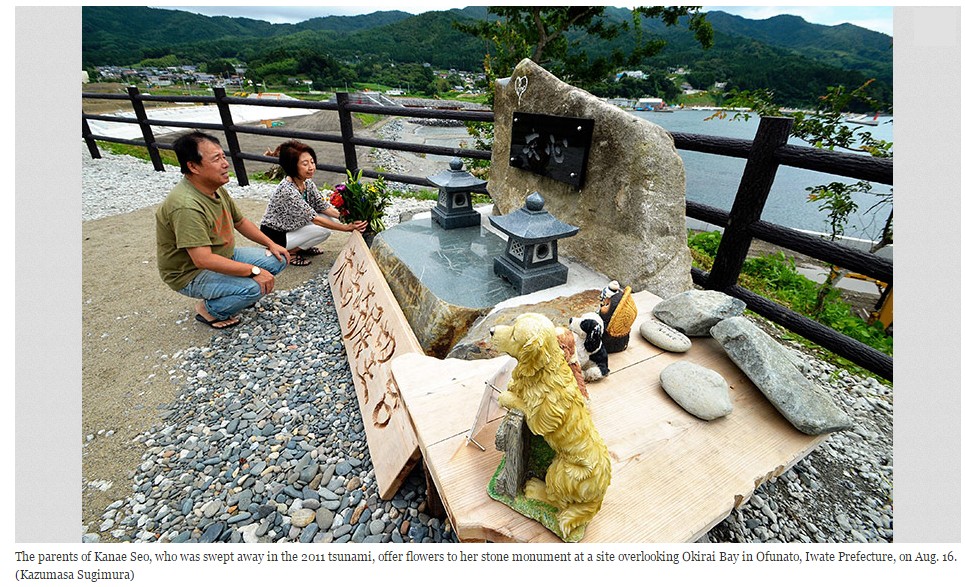
Monument for tsunami victim gets permanent home

By KAZUMASA SUGIMURA/ Staff Writer

http://ajw.asahi.com/article/0311disaster/life_and_death/AJ201509110001

Ofunato

OFUNATO, Iwate Prefecture–A stone monument in honor of a university student who was last seen helping an elderly woman flee the 2011 tsunami has become a memorial for all disaster victims in the Okirai district here.

The monument was relocated to higher ground at a hilltop site overlooking Okirai Bay in Ofunato.

The area is where Kanae Seo, a second-year student of the School of Marine Bioscience at Kitasato University’s Sanriku Campus, assisted a woman in a wheelchair after the Great East Japan Earthquake struck on March 11, 2011.

The elderly woman survived. But Kanae, then 20, was swept away by the ensuing tsunami.

Her body has not been found.

Kanae lived alone near the campus. She loved nature and had become so fond of the people in the community that she declared she would not return to her home in Tokyo’s Nerima Ward after graduation.

After a long search for their daughter, Kanae’s father, Shinji, 61, and mother, Hiromi, 57, erected the stone monument on a coastal plot provided by a local resident in March last year. They thought the location was perfect for their ocean-loving daughter because it faced the sea.

Kanae always valued her relations with friends, so Shinji inscribed the kanji for “yushin” (friendly heart) on the stone.

However, construction of a coastal levee forced the parents to consider moving the monument.

Incidentally, a local community development committee planned to build a lookout with a view of town and the sea that could serve as a memorial for the more than 90 residents who were killed or disappeared in the tsunami.

The committee offered to move Kanae’s monument to the site in mid-July, and many people have since visited.

The hill offers a view of Okirai Bay, where Kanae fished at night, and the site of the apartment where she lived.

“I cannot believe her monument has been moved to such a wonderful place,” Hiromi said. “I am so grateful that the locals have accepted Kanae as an Okirai woman.”

Atomkatastrophe in FukushimaJapan gibt ersten Ort für Bewohner frei

http://www.tagesschau.de/ausland/fukushima-rueckkehr-105.html

Atomkatastrophe in FukushimaJapan gibt ersten Ort für Bewohner frei

Stand: 05.09.2015 11:15 Uhr

Rund 7400 Einwohner aus dem japanischen Naraha dürfen gut viereinhalb Jahre nach der Atomkatastrophe von Fukushima in ihre Heimat zurückkehren. Es ist die erste Ortschaft in der Region, die von den Behörden vollständig freigegeben wurde. Doch die Menschen bleiben wohl fern.

Dekontaminationsarbeiten im Juli 2015 im japanischen Nahara | Bildquelle: AFP

Dekontaminationsarbeiten im Juli 2015 im japanischen Naraha

Mehr als vier Jahre ist die Atomkatastrophe von Fukushima her. Damals evakuierte die japanische Regierung die Ortschaft Naraha, die im Umkreis des betroffenen Kernkraftwerks liegt. Nun wurde die Evakuierungsanordnung aus dem Jahr 2011 aufgehoben, die knapp 7400 Einwohner dürfen in ihre Heimat zurückkehren.

Naraha ist damit die erste Gemeinde, in die alle Bewohner nach der Atomkatastrophe dauerhaft zurückkehren dürfen. „Der eigentliche Wiederaufbau unserer Stadt beginnt jetzt“, sagte der Bürgermeister Yukiei Matsumoto in einer Fernsehansprache. „Lasst uns zusammenarbeiten für die Schaffung eines neuen Naraha.“

Nur wenige Einwohner werden wohl zurückkehren

Die Rückkehr in den Ort wird als Pilotprojekt für andere Gegenden in der Nähe von Fukushima angesehen. Die Regierung von Ministerpräsident Shinzo Abe will bis März 2017 eine Reihe von Evakuierungsanordnungen aufheben.

Doch angesichts verbreiteter Ängste vor einer noch bestehenden radioaktiven Verseuchung und der Sorge, dass nicht genügend Bürger zurückkehren könnten, um die Gemeinde wieder aufzubauen, werden nur etwa zehn Prozent der ehemals 7368 Einwohner von Naraha zurückerwartet. Viele junge Menschen haben an anderen, weit entfernten Orten neue Jobs gefunden. Die Zukunft Narahas ist somit ungewiss.

Jahrelange Dekontamination der Region

Die Regierung hat die betroffenen Gebiete um Fukushima einer aufwendigen Dekontaminierung unterzogen. Dadurch sei sei die Strahlenbelastung in vielen Regionen reduziert worden, erklärten die Behörden. Naraha sei nun sicher. Aktivisten beklagen jedoch, dass viele Gegenden nach wie vor hohe Strahlenwerte aufweisen und damit unbewohnbar seien.

Im Atomkraftwerk von Fukushima war infolge des schweren Erdbebens und Tsunamis am 11. März 2011 das Kühlsystem ausgefallen, woraufhin es in mehreren Reaktoren zur Kernschmelze kam. Drei der sechs Reaktoren wurden bei der Katastrophe zerstört, das Gebiet im Umfeld wurde radioaktiv verseucht. Durch das Erdbeben und den Tsunami kamen rund 18.000 Menschen ums Leben.

楢葉へ帰還、苦難の一歩 避難解除―戻った住民1割未満 「医者いない、店ない」

写真・図版久しぶりに自宅で夕食後のだんらんを楽しむ根本次夫さん(66)一家。「(避難指示解除の)初日だからくっぺ」と妻と長女を誘って帰って来た。年末やお盆などの節目には家族そろって過ごすという=5日夜、福島県楢葉町、福留庸友撮影

Evakuierte Einwohner dürfen in ihre Heimat zurückkehren – z.B. Naraha – Die Strahlenbelastung liegt zwischen 0 und 3 Microsievert. Unter 10% der ehemaligen Einwohner wollen zurückkehren. Es gibt keine Läden, keinen Arzt.

  • 写真・図版

 東京電力福島第一原発事故福島県楢葉(ならは)町に出ていた避難指示が5日、解除された。全自治体規模で解除されるのは初めて。戻ってきたのは、住民7400人のうち1割にも満たない。事故から4年半がたち、町は廃炉の前線基地へと変わった。いまだ避難指示が出ている福島県内9市町村の7万人余りは帰還できるか。政府が試金石とする町の復興は始まったばかりだ。▼39面=住民の思い

5日、町内で開かれた復興祈念式典には政府関係者がずらりと並んだ。仮設校舎で学ぶ子どもたちは植樹したエノキを「きぼうの木」と命名。町は祝賀ムードに包まれた。

昨年7~11月の調査では住宅地の空間線量の平均が毎時0・3マイクロシーベルトにまで下がり、政府は「帰還して居住することは可能」と説明する。だが、町の水がめの木戸ダムの湖底の土から放射性物質が検出され、飲料水の安全を心配する住民は少なくない。

町の姿は事故前とは大きく変わった。空き家状態だった多くの民家が荒れた。事故で原則立ち入りが禁じられる警戒区域に指定されたが、2012年8月から日中の立ち入り、今年4月からは宿泊もできるようになった。だが、住宅の解体や修理を担う業者が足りず、再建が進んでない。

町に戻った住民は一部にとどまる。自宅に戻る準備をするための宿泊制度に登録していたのは351世帯780人程度。実際に戻った人はさらに少なく全体の1割に届かない。

「医者もいないし、店もない」。町に戻った志賀良久さん(77)は生活の不便さを訴える。町内にあった内科医院は10月に再開され、県立診療所も来年2月に開院する。だが、住民が通院していた近隣自治体の医療機関は避難指示が出ており、閉鎖されたままだ。

町内で食料品を買えるのは仮設商店街にあるスーパーとコンビニ店のみ。町商工会によると、事故前に59店舗あった会員の小売店や飲食店のうち、先月20日までに町内で営業を再開したのは14店舗にとどまる。

4年半に及ぶ避難生活で、避難先で職をみつけ、学校に通うなどして、現役世代や子どもたちを中心に避難先で定住することを決めた人も多い。いわき市仮設住宅に住む無職男性(61)は市内に中古の一戸建てを買った。「楢葉町は治安と飲み水が心配だ」と話す。

■「復興拠点に」国は後押し

政府は、避難指示が出た区域の中では放射線量が比較的低い楢葉町を「復興の拠点」と位置づける。除染や道路、病院などを整備して町の復興を後押ししてきた。政府にとって今回の解除は、帰還政策がうまくいくかを占う試金石となる。

楢葉町は廃炉作業の前線基地となりつつある。関連産業に伴う新たな雇用を作り出し、元の住民が戻る環境を整えようとしている。

町の工業団地には、廃炉技術を研究する原発の大型模型(モックアップ)が建設中だ。日本原子力研究開発機構が運営し、研究者ら60人が勤める予定。滞在を当て込み、17年秋には町で初めてビジネスホテルが進出する。東電の関連企業の社員の宿舎も建つ。

災害公営住宅などを建てる「コンパクトタウン」には、ホームセンターや食料品店が入る商業施設をつくる計画もある。しかし、どれだけの雇用が生まれ、町にどれだけの人が戻ってくるのかは未知数だ。

福島県内では9市町村の7万人余りが戻れず、6町村は自治体丸ごと避難指示が出ている。政府は、放射線量が一定量以下に下がった地域は「17年3月までに帰れるようにする」ことを掲げる。来春には南相馬市や川俣町、葛尾村でも避難指示を解除したい考えだ。

福島第一原発のある大熊、双葉両町の大部分など放射線量の高い帰還困難区域(人口約2万4千人)は解除のめどが立たない。両町にまたがる16平方キロは、福島県内の放射能に汚染された土を30年間保管する、中間貯蔵施設となる予定だ。双葉町幹部は「5年後も何も改善していないかもしれない」と話す。

(長橋亮文

入居長期化…仮設の一斉点検始まる

Es ist erschreckend!

宮城

入居長期化…仮設の一斉点検始まる

2015年09月03日 木曜日
仮設住宅の使用の長期化に備え、屋根や床下の状況を確認する作業員

 東日本大震災で整備したプレハブ仮設住宅の入居が長期化するのを踏まえ、宮城県は2日、気仙沼市の市総合体育館駐車場仮設住宅(89戸)を皮切りに、仮設住宅の一斉点検を始めた。

委託を受けた業者の作業員8人が、住宅の床下をのぞき込みながら床を支える木ぐいを点検。屋根や外壁、給湯器の凍結防止ヒーターの状態も確認した。入居する主婦小野寺裕子さん(59)は「災害公営住宅が完成するまで2年以上あるので、安心して暮らせるようにしてほしい」と求めた。

県による一斉点検は初めて。震災6年目となる2016年度以降も使う13市町366団地、約1万3600戸を対象に実施し、補修も行う。17年度以降も使う住宅は金属製の支えで基礎部分を補強する。仙台市でも7日に点検を始める。

7月末現在で、県内の仮設住宅の入居者は2万9498人、入居率は62.8%。

宅地造成などが遅れ、仮設住宅暮らしは20年まで続くとみられている。

Ansprache zum Weltkriegsende vor 70 JahrenJapans Premier Abe beugt sich dem Druck

14. August 2015, 17:03 Uhr

Ansprache zum Weltkriegsende vor 70 JahrenJapans Premier Abe beugt sich dem Druck

Reue in indirekter Rede: Japans Premier Shinzo Abe

(Foto: dpa)

„Aggression“, „Kolonisierung“, „tiefe Reue“, „Entschuldigung von Herzen“: In der Rede des japanischen Ministerpräsidenten Abe zum Zweiten Weltkrieg steht drin, was drin sein muss. Aber nicht mehr.

Premier Shinzo Abe hat das Minimum getan. In seiner Erklärung zur siebzigsten Wiederkehr der Kapitulation Japans hat er die vier Stichworte erwähnt, die in Peking und Seoul zur conditio sine qua non für bessere Beziehungen gelten, insbesondere für ein Gipfeltreffen.

Er bezeichnete Japans Krieg gegen seine Nachbarn als „Aggression“ und die Unterwerfung Koreas als „Kolonisierung“; er drückte „tiefe Reue“ aus für die „unmessbaren Schäden und das Leid“, die Japan über andere Länder brachte. Und mehrfach benutzte er das Wort „Entschuldigung von Herzen.“ Er stehe zu den Erklärungen seiner Vorgänger, die sich vor zehn und zwanzig Jahren „von Herzen entschuldigten“, versicherte er. An ihnen werde „nicht gerüttelt, auch in Zukunft nie“.

Abe ist einen weiten Weg gegangen. Noch vor einem halben Jahr wollte er weder von „Aggression“ sprechen – das sei ein international nicht definierter Begriff – noch etwas von einer Entschuldigung hören.

Bei seinem Amtsantritt hatte er die Erklärung von Premier Tomoiichi Murayama, der sich 1995 als erster Regierungschef für Japans Greueltaten entschuldigte, sogar widerrufen wollen. Doch der Druck nahm stetig zu, auch aus der eigenen Partei.

Deshalb überlegte Abe zwischendurch, gar keine Erklärung der Regierung abzugeben, sondern bloß eine persönliche. Eine eigens geschaffene Kommission, in die er mehrheitlich Konservative berief, hielt ihn davon ab. Die 16 Experten kamen zum Schluss, er müsse die vier Stichwörter erwähnen, sie seien angebracht. Und natürlich müsse es eine offizielle Erklärung der ganzen Regierung sein.

Der ebenfalls nationalistische Junichiro Koizumi, 2005Premier und einst Abes Mentor, sagte vor zehn Jahren in seinem kurzen konzisen Statement: „Ich drücke meine tiefe Reue und meine herzliche Entschuldigung aus.“

Abe dagegen sprach in einer langen Rede von einer Entschuldigung von Herzen, die abgegeben worden sei, vermied es aber sorgsam, dabei in der ersten Person zu sprechen. Er hätte sich damit auch für seinen Großvater Nobusuke Kishi entschuldigt, der im Kriegsregime eine Schüsselrolle spielte. Und den Abe als Vorbild verehrt.

Yutaka Yoshida, Professor an der Hitotsubashi-Universität, kommentierte im Fernsehen: „Abe hat so formuliert, dass die Entschuldigung indirekt war. Man muss sich fragen, ob er sie wirklich gemeint hat.“

Diese Frage hat Abe längst beantwortet. Seine Einschätzung hat er nicht geändert, er hat nur dem Druck nachgegeben, auch dem Druck eines großen Teils der Japaner, auch von fünf ehemalige Regierungschefs, die ihn vor wenigen Tagen ermahnt hatten.

USS SHAW EXPLODES AT PEARL HARBOR IN 1941

Japan und der Zweite Weltkrieg Sehenden Auges in die Katastrophe

New film by Doris Doerrie about Minamisoma

Seelenreparatur im Sperrgebiet

Die deutsche Regisseurin Doris Dörrie dreht bereits ihren dritten Film in Japan. «Grüsse aus Fukushima» erzählt eine Geschichte um zwei Frauen in der verstrahlten Zone.

Marie aus Deutschland (Rosalie Thomass) hilft Satomi (Kaori Momoi) dabei, deren Haus in der radioaktiven Zone zu renovieren. Foto: Mathias Bothor (Majestic)

Marie aus Deutschland (Rosalie Thomass) hilft Satomi (Kaori Momoi) dabei, deren Haus in der radioaktiven Zone zu renovieren. Foto: Mathias Bothor (Majestic)

Marie überragt ihre Schülerinnen, die meisten so alt wie ihre Grossmutter, kurz gewachsene Oba-chan, wie man in Japan Frauen jenseits der Jugend liebevoll nennt. Die Oba-chan, die seit bald vier Jahren in der Notsiedlung wohnen, geben sich Mühe beim Hula-Hoop; sie freuen sich über Abwechslung. Aber sie haben kein Talent. Marie seufzt ein japanisches Danke, für heute ist Schluss. Beim Einsammeln der bunten Reifen knallt sie mit Satomi zusammen, der letzten Geisha des Ortes, die auch in einem Container Zuflucht gefunden hat. Satomi, gespielt von der 63-jährigen Kaori Momoi, ein Star in Japan, hat beim Hula-Hoop nicht mitgemacht, aber zugeschaut. Sie kann das, sogar mit vier Reifen zugleich, wie sie Marie verächtlich demonstriert. Dann rotzt sie der jungen Deutschen ein «Bullshit» ins Gesicht. Sie hat die Nase voll.

Seit voriger Woche dreht die Regisseurin Doris Dörrie in dieser Containersiedlung ihren nächsten Spielfilm: «Grüsse aus Fukushima». Die Oba-chan sind keine Schauspielerinnen, sie wohnen tatsächlich in der grauen Containersiedlung. Das Erdbeben und der Tsu­nami haben ihr Dorf Odaka eine halbe Autostunde weiter südlich verwüstet; zudem liegt es in der Sperrzone.

Wie schon in früheren Filmen erzählt Dörrie ihre Geschichte so, dass auf dem Originalschauplatz der Alltag weitergeht. Das zwingt die Crew zuweilen zu Improvisationen. «Aber mit unserem kleinen Team sind wir sehr beweglich», sagt Dörrie. In «Grüsse aus Fukushima» drängt sich der Originalschauplatz und das Schicksal seiner Bewohner in den Vordergrund: 125’000 Menschen hausen noch immer als Nuklearflüchtlinge in Notunterkünften. Die Welt hat sie vergessen. In Tokio tut man so, «als habe es die Katastrophe nie gegeben», so Dörrie. Einige Orte in der Sperrzone sind inzwischen wieder offen, die Regierung versucht, die Leute in ihre Dörfer zurückzuschicken. Doch wer heimkehrt, oft in ein beschädigtes Haus und ohne die alte Infrastruktur, etwa den Einkaufsladen um die Ecke, verliert jede staatliche Unterstützung. Damit sind viele Menschen Gefangene in den Provisorien, an die sich manche bereits gewöhnt haben. Einige Alte möchten ihre Container nicht mehr verlassen, sie wollen nicht noch einmal aus ihrem Leben gerissen werden.

Andere Flüchtlinge zerbrechen an der Existenz im Container, vor allem Männer. Sie leiden an Depressionen, es gibt immer wieder Suizide, viele saufen oder versacken in Spielhöllen. Dagegen kämpfen die Frauen an, indem sie beispielsweise Tanz- und Strick­gruppen bilden oder Veranstaltungen zu organisieren versuchen.

Plötzlich nur noch widerwillig

Auch Marie versucht mit ihren Hula-Hoop-Lektionen, die Flüchtlinge aufzumuntern. Die Oba-chan sind begeistert. Doris Dörrie, die alle überragt, aber kaum Anweisungen gibt, inszeniert nicht nur Unterhaltung zwischen den Containern; die Dreharbeiten sind selber eine solche Abwechslung, wie sie die Menschen im Containerdorf brauchen. Die Begeisterung der Oba-chan gilt freilich vor allem der Schauspielerin Kaori Momoi, mit der sie über die Jahre vor dem Fernseher älter geworden sind. Nun gehört sie für ein einige Wochen fast zu ihnen. Allerdings verlieren die Oba-chan bald die Geduld, wenn Dörrie eine Szene noch einmal und dann auch noch aus einem anderen Winkel drehen will. Plötzlich machen sie nur noch ­widerwillig mit, wollen dringend etwas Wasser. Sie verstehen auch nicht recht, warum sie das Hula-Hoop-Tanzen für den Film noch schlechter beherrschen sollen, als sie es ohnehin können.

Risiko vorher abgeklärt

Eigentlich ist auch Marie ein Flüchtling. Sie hat ihre grosse Liebe versemmelt und flieht gebrochenen Herzens aus Bayern nach Fukushima, um dort zu helfen, wo die Menschen wirklich leiden. «Wie die meisten Leute wusste sie nur theoretisch, vom Fernsehen, worauf sie sich einliess. In der Containersiedlung ist sie komplett überfordert», erzählt Doris Dörrie.

Ein bisschen hätten sie diese Überforderung auch als Filmcrew erlebt, gesteht Dörrie. Vor der Katastrophe war Minamisoma ein Provinznest, zu dem ein verstreuter Haufen verschlafener Dörfer gehört. Der Süden des Gemeindegebietes musste evakuiert werden, er liegt innerhalb der Sperrzone um Fukushima I, wo drei Reaktoren durchgeschmolzen sind. Doch auch aus dem übrigen Teil flohen viele Leute, vor allem Familien mit Kindern. Minamisoma wurde zum Geisterort. Inzwischen funktioniert die über­lebenswichtige Infrastruktur wieder, auf der grünen Wiese gibts ein neues Einkaufszentrum. Aber das Geflecht feiner Strukturen, in denen ein soziales Leben stattfindet, lässt sich nicht einfach neu bauen. Dörrie ist mit ihrem Team in ­einem eiligst hochgezogenen Budget­hotel untergekommen, einem Plattenbau am Strassenrand. Es gibt keine Kneipe, nur einen Getränkeautomaten.

Dass «Grüsse aus Fukushima» kein normaler Dreh ist, zeigt sich schon auf der Herfahrt. An der Autobahnrampe informiert eine Anzeigetafel über die Strahlung hinter der Kraftwerksruine: an diesem Vormittag sind es 0,2 – 5,6 Mikrosievert. Sie habe das Risiko vorher mit Experten in Deutschland abgeklärt, versichert Dörrie. «Kein Film ist es wert, dass man seine Gesundheit riskiert.»

In einer zweiten Szene, die an diesem Mittwoch gedreht wird, klopft die frustrierte alte Geisha an Maries Containertür und fragt, ob die Deutsche Auto fahren könne. Satomi will ihr zerstörtes Haus in der Sperrzone besuchen. Und weigert sich dann, ins Containerdorf zurückzukehren. Die beiden Frauen nähern sich einander an. Bis Satomi Marie einspannt, mit ihr das Haus zu reparieren. Das wird zum Lernprozess für beide Frauen, der Film ist eine Education sentimentale beider Frauen. «Im grossen japanischen Kino gibt es zahlreiche Lehrer-Schüler-Geschichten», sagt Dörrie, aber immer seien der Sensei, also der Lehrer, und sein Lehrling Männer. Sie wolle Frauen zeigen. Zumal im verknorkst patriarchalen Japan zumeist die Frauen den Karren ziehen.

«Man tut, als sei nichts passiert»

«Grüsse aus Fukushima» wird Dörries dritter Japan-Film. In «Erleuchtung garantiert» (1999) reisen zwei Deutsche nach Japan, um sich in einem Zen-Kloster zu finden, verlieren sich zuvor aber in Tokio. In «Kirschblüten» (2008) findet ein frisch verwitweter Beamter aus Schongau am Fusse des Fuji die Versöhnung mit sich selbst. In beiden Filmen hilft Japan den Besuchern aus Deutschland, obwohl es sie kaum als Individuen wahrnimmt. Dazu ruht Nippon viel zu sehr in seinem streng geregelten Chaos.

In «Grüsse aus Fukushima» – der Film soll nächstes Frühjahr starten – verkehrt sich das. Im Containerdorf ist Marie eine besonders auffällige Besucherin, die jedoch von allen wahrgenommen wird; und der es sogar gelingt, Satomi zu helfen. Ist mit der Dreifachkatastrophe von Fukushima das Tröstende Japans, das passiv Heilende aus den früheren Filmen etwas verschwunden? Dörrie zweifelt: «Fukushima hat uns in Deutschland geholfen, aus der Kernenergie auszusteigen. Aber Japan tut, als sei nichts passiert. Im Winter heizen sie die Häuser auf 24 Grad, im Sommer kühlen sie sie auf 16 Grad. Und sie lassen die Autos ständig laufen.» Und die Flüchtlinge in den Containersiedlungen würden im Stich gelassen. Dann stockt sie: «Aber das Kino ist keine Erziehungsanstalt.»

(Tages-Anzeiger)

(Erstellt: 31.05.2015, 19:37 Uhr)

Sanriku fishermen prepare houses to lure young workers

Sanriku fishermen prepare houses to lure young workers

The Yomiuri Shimbun

Shota Abe, left, and others stand inside a vacant house they are remodeling to accommodate fishermen in Ishinomaki, Miyagi Prefecture, on June 29.

http://www.the-japan-news.com/news/article/0002281783

4:00 am, July 23, 2015

The Yomiuri ShimbunSENDAI — Local fishermen of Miyagi Prefecture’s Sanriku region, which was struck hard by the 2011 Great East Japan Earthquake and tsunami, are to begin the new challenge of setting up shared houses by remodeling vacant houses for young people who aspire to become fishermen. They hope this will help solve a severe labor shortage in the local industry due to the disaster.

The number of official members of the local fishermen’s associations in Miyagi Prefecture dropped by about 30 percent compared to the pre-quake fiscal 2010 figure, according to the Miyagi prefectural fishermen’s cooperative and others. Many old fishermen quit their professions after losing their fishing vessels to tsunami and failed to find young people to be successors to their business.

“Our industry will be ruined unless we find successors from outside,” became an urgent refrain in the community.

Spurred by this, Shota Abe, a 29-year-old local seaweed farmer, and Shingo Suzuki, a 27-year-old local silver salmon farmer, came up with the idea to build shared houses to combat the lack of accommodations available. Abe, an Ishinomaki resident, and Suzuki, an Onagawa resident, are also members of Fisherman Japan, an organization that promotes the fishery industry in the Sanriku area.

They are currently remodeling two vacant houses in Ishinomaki and Onagawa. Both are wooden one-story houses built about 40 years ago and belong to their relatives. After the remodeling, each house will have three individual rooms and a common space.

Former postal clerk Shinsuke Oizumi, 30, has decided to move into the shared house in Ishinomaki. Oizumi is currently training to be a fisherman, after moving from Shiogama in the prefecture. Although he does not have any experience as a fisherman, he said, “I’m determined to fish for the rest of my life here.”

Abe and Suzuki are also planning to accept seasonal part-time workers.

“I want to build more and more shared houses where young fishermen can live on the beach of Sanriku in an effort to increase the number of young people as much as possible,” said Abe.

Tsunami survivors open new town on Miyagi farmland

The town of Tamaura-Nishi is born in Iwanuma, Miyagi Prefecture, on July 19. (Provided by Takeki Izumi, assistant professor at Tokyo Metropolitan University)

The town of Tamaura-Nishi is born in Iwanuma, Miyagi Prefecture, on July 19. (Provided by Takeki Izumi, assistant professor at Tokyo Metropolitan University)

  • The town of Tamaura-Nishi is born in Iwanuma, Miyagi Prefecture, on July 19. (Provided by Takeki Izumi, assistant professor at Tokyo Metropolitan University)
  • The Tamaura-Nishi district in Iwanuma, Miyagi Prefecture, in November 2013 (Asahi Shimbun file photo)
July 20, 2015

By HIDEAKI ISHIBASHI/ Staff Writer

IWANUMA, Miyagi Prefecture–They prayed for their lost loved ones, reminisced about their agony and despair and thanked the people who came to their rescue. And then, more than 800 survivors of the 2011 earthquake and tsunami started their new lives in a recently completed town built on nearly 20 hectares of what was once farmland.

The town of Tamaura-Nishi was born on July 19 within the city of Iwanuma, four years and four months after the Great East Japan Earthquake and tsunami slammed coastal areas of the Tohoku region.

People from six tsunami-devastated communities in Iwanuma relocated to Tamaura-Nishi. It is the first new town with more than 100 households from municipalities affected by the disaster.

The town’s inauguration ceremony was held at a citizens hall on the morning of July 19. It started with a silent prayer for the 181 residents of Iwanuma who were killed in the tsunami.

Miyu Sakurai, 15, a third-year junior high school student, talked about her optimism for the new town in a speech she gave at the ceremony.

“I am very happy because I can study in my own room. I am proud of the fact that Tamaura-Nishi is my hometown,” said Sakurai, who lived in a temporary housing facility for about four years after her house was washed away by the tsunami.

Yoko Saito, 52, also took the stage and talked about her feelings of helplessness when she saw how the tsunami had reduced her previous neighborhood of Hasegama, one of the six communities, to rubble in 2011.

“I was filled with extreme anxiety, thinking, ‘How will I live from now on?’” she recalled.

Saito was also at a loss on whether to join the group relocation to the Tamaura-Nishi district. She eventually decided to relocate there after her eldest daughter, Aya, 26, said, “We should join the relocation because we like Tamaura.”

Their new house was completed in July 2014. Showing a photo of her family taken at that time, Saito said, “This smile is a present from all of you.”

Iwanuma city is considered a forerunner in reconstruction from the 2011 disaster, but building a town from scratch required special coordination.

“It was good that each community had leaders, and that they were quick in making decisions,” said Hiroo Kikuchi, the 62-year-old mayor of Iwanuma.

The Tamaura-Nishi district was chosen as the relocation site in November 2011, eight months after the quake and tsunami.

From June 2012, leaders from the six communities held 28 meetings on what type of town they would create.

The town of Tamaura-Nishi was built on a farmland area measuring 750 meters by 250 meters and about 3 kilometers from the coast. The entire project cost about 19.6 billion yen (about $158 million).

Sales or leases of 158 plots started in December 2013. In addition, 178 completed houses were offered for rent. Actual relocations to the new town began in April 2014.

A total of 833 people from 315 households have moved to the area, accounting for 60 percent of residents from the six communities. The remaining 40 percent, mainly families with young children, have relocated elsewhere.

The name of the town was selected through voting by residents. Junior high school students came up with the names of four parks in Tamaura-Nishi.

A large supermarket was opened in Tamaura-Nishi on July 7 and has since been attracting customers even from areas outside the town.

“Since the disaster, we have been making efforts together and have shared the same thoughts,” said Katsuyoshi Nakagawa, 76, who coordinated the opinions from the six communities. “That has led to the birth of a good town.”

On the afternoon of July 19, residents of the Tamaura-Nishi district unveiled a monument in the new town and expressed gratitude to all people concerned.

At the end of the event, residents performed a mid-summer Bon-odori dance, the first time in five years that the traditional dance festival has been held.

“Today is the starting day of our hometown,” one of the residents said.

By HIDEAKI ISHIBASHI/ Staff Write

EDITORIAL: Support must continue to help Fukushima evacuees rebuild their lives

July 09, 2015

Residents of Naraha gather at a festival in March to pray for the reconstruction of the town affected by the accident at the Fukushima No. 1 nuclear power plant. (Asahi Shimbun file photo)

The government has decided to lift evacuation orders for wide areas around the disaster-stricken Fukushima No. 1 nuclear power plant and end blanket compensation payments to people in Fukushima Prefecture who are still suffering from the aftermath of the reactor meltdowns.

More than four years since the nuclear disaster, the uncertain future of the affected local communities and their members is causing further negative effects.

Setting clear dates for lifting evacuation orders will make it easier for evacuees to plan their futures. The move is also meaningful in terms of clarifying the government’s responsibilities to improve the environment for the evacuees’ return home through such measures as decontamination and rebuilding infrastructure related to their daily lives.

But the conditions are not the same for each disaster victim. The move to lift evacuation orders and end compensation payments should not be a simple termination of policy support. It is essential for the government to start fresh support based on careful consideration of the circumstances of individual sufferers.

POSSIBLE BOOST TO RECONSTRUCTION EFFORTS

The government has set clear dates for lifting the evacuation orders for two of the three categories of restricted areas—“areas to which evacuation orders are ready to be lifted” and “areas in which the residents are not permitted to live.” The levels of radiation in these areas are relatively low, and entry into these areas is permitted in the daytime.

The evacuation orders for these areas will be removed by March 2017 at the latest after accelerated decontamination efforts.

The people of Naraha, a town that has been entirely designated as “an area to which the evacuation order is ready to be lifted,” will be allowed to return home on Sept. 5.

The town will be the first among seven municipalities to have an evacuation order for all residents lifted since the meltdowns at the plant in March 2011.

For the residents to be able to start living in the town again, however, it is vital to repair or rebuild damaged houses and secure jobs for the returnees.

Major homebuilders have been reluctant to work in evacuation areas, saying they can’t carry out operations until the evacuation orders are lifted.

Since it was stuck by the disaster, Naraha has persuaded 11 companies to locate their plants in the town. All but one of these companies, however, have been waiting for the removal of the evacuation order to start building the plants.

The scheduled end of the evacuation will bolster efforts to rebuild the community. In a survey of evacuated Naraha residents conducted last autumn, 45.7 percent of the respondents said they would return to their homes in the town either “immediately” or “when necessary conditions are met” after the evacuation order ends. The figure represents an increase of 5.5 percentage points from the previous survey.

But it will be difficult to completely restore the status quo. Many evacuee families have members who are already working at places where they currently live or children who have grown accustomed to their new schools.

NO RETURN TO PRE-DISASTER LIFE

Evacuation orders for parts of Tamura and Kawauchi have already been lifted, but only about half of the residents of these areas have returned.

If the population of an area doesn’t recover sufficiently, it will be difficult to operate such public facilities as medical institutions and schools in the area. This further discourages residents from returning.

Farmers and self-employed people in such areas also face a tough time trying to restart their businesses.

Concerns about radioactive contamination of food grown in disaster areas will remain even though test growing of certain crops has started in some areas. Part of local farmland has been used for provisional storage of soil and plant debris from the decontamination work. Heaps of large bags filled with contaminated materials remain at many sites.

A survey by the Fukushima Federation of Societies of Commerce and Industry of members in evacuation areas found that 56.4 percent of the respondents had restarted their businesses either in or outside the prefecture by June this year.

But most of them are construction or manufacturing businesses, while only a few of the affected retailers and service providers have started doing business again. That’s because their trade areas have disappeared.

After the evacuation order for the Miyakoji district of Tamura was lifted in April last year, a temporary store to sell foodstuffs and daily necessities was opened under the government’s leadership. A convenience store was then opened along a national highway under the initiative of the government. Sales at the store have plunged to a quarter of their peak level partly because of route sales of another convenience store.

In Naraha, a local supermarket is struggling to rebuild. It is concerned about a possible blow to its operations from a new store of retail giant Aeon Co. that is expected to open within a commercial complex built by the neighboring town of Hirono along a national highway.

Amid these circumstances, compensation payments to disaster victims by the government and Tokyo Electric Power Co., the operator of the Fukushima No. 1 plant, will be discontinued.

Compensation for mental health damage (or consolation money of 100,000 yen per month per person) will end after the payments for March 2018. Compensation for damage to businesses paid to small and midsize companies and self-employed people that remain out of business will be terminated after the payments for March 2017.

Critics have been pointing out problems with the way such compensation has been paid to people and businesses damaged by the disaster. They say the compensation programs widen the economic disparity between the recipients and those who don’t receive the money, divide communities and hinder victims’ efforts to regain economic independence.

PAY ATTENTION TO DIFFERENT CONDITIONS OF INDIVIDUALS

But rebuilding shattered lives entails formidable challenges. Consolation money is often used to cover living expenses.

If evacuees can’t find a way to earn a living in their towns, they will be unable to make ends meet when they return to their homes after the evacuation order is lifted.

The government plans to set up a new public-private organization to help self-employed people and farmers restart their businesses in the next two years. The new body will start its work by visiting 8,000 such people for counseling by the end of the year.

But there is still no plan for specific steps to be taken. It will take considerable time just to grasp what kind of situation they are in.

Fuminori Tanba, an associate professor at Fukushima University who has been involved in the development of reconstruction plans for many disaster-hit areas, points out some key factors for successful support to such businesses.

It is crucial to draw up a detailed prescription for each business to sort out the challenges it faces, he says. It is also important to take measures to coordinate the trade areas of similar businesses and retrain those who are seeking to change their businesses.

Tanba also stresses the need to pay attention to problems these people face after restarting their businesses to ensure that they will get on track.

In short, policy support should be provided through the entire process of business reconstruction.

In addition to such support, the government should consider creating a public framework to provide financial aid to cover living expenses for people struggling to rebuild their livelihoods.

These people are suffering from a disaster that happened at a nuclear power plant built under the government’s policy of promoting nuclear power generation. The government should not end financial aid to individual residents of the affected areas.

Four years since the harrowing accident, the conditions of individual residents of areas around the crippled plant remain complicated.

It is necessary for the government to make flexible responses to their needs from their own viewpoints. Now is the critical moment for work to rebuild the lives of people in Fukushima that were destroyed by the disaster.

–The Asahi Shimbun, July 9

Homes with heart for Sendai

Homes with heart for Sendai

Credit: Mark Hanauer
July 8, 2015 by Mary Daily

When the 2011 Tohoku earthquake and subsequent tsunami hit Japan and wiped out much of Sendai, the hometown of UCLA architecture and urban design chair Hitoshi Abe, he resolved to make the reconstructed city more people-friendly than the one that was destroyed. UCLA Magazine editor Mary Daily talked to the world-famous architect about his work there and the group he and his colleagues formed to help Japan rebuild.

How did you hear about the quake?

I was at home, looking through a Yahoo site to check out the Japanese news, when information on the quake popped up. I was shocked—“Oh my God!“ I knew there’s usually a big quake there every 40 years, but this was way bigger. And the tsunami we didn’t expect at all. For two days I couldn’t communicate with my parents. On the news, it looked like the area was completely overtaken by water. I saw the fires and all the destruction. Finally, on the third day, I was able to reach my brother, and he told me everybody was OK. But there was no way for me to get there until a month later.

Once there, were you shocked by what you saw?

Nowadays most of what they show on TV is shocking, so that creates a horrible mental image. But it wasn’t until I got there that I realized how large the disaster actually was. The water had destroyed the coastline. Nothing remained. I saw a five-story concrete building tipped and moved, and a piece of road, thick asphalt, sitting on the pier. The power of the water is beyond the imagination.

How did you follow up?

Many friends emailed me, asking if I was OK. Everybody thought I was in the middle of it, but I was in California at the time. I felt bad that I wasn’t there. Then my architect friends and I began to say maybe there’s something we can do. About a week later we formed a group called ArchiAid, through which we could share information and collaborate on the reconstruction of the community. The group has grown to 300 members. Our goal was to assist in reconstruction through an international network, develop practical reconstruction and educational services, and accumulate and promote knowledge.

Is this a new idea—for architects to give input after a disaster?

This was the first time for our generation. We had to do it because in Japan, during disasters, the central government does not include architects in the recovery and master planning. In order to rebuild quickly, the planning is driven by civil engineers in a top-down manner. Even a leading architect who is internationally famous couldn’t influence the government to involve architects.

What are the special contributions of architects in this case?

Because the devastation covered a 400-mile-long coastline, the conditions are unique at each point. These are sensitive conditions. There is not much local industry, the population is older and each area has to be addressed with consideration of its culture, history, people and community. Civil engineering is more about preventing disaster damage, or reconstructing cities and towns in a technical way through which the sensitive local and community aspects are lost. The engineers presented a very dry proposal for the central government to fund and implement, creating lots of potential conflict and frustration within the community. Their aim was just to get people into safe housing as quickly as possible.

When somebody proposes something awful, local businesses and residents can only complain. It is difficult for them to be organized and create alternate proposals. They need a vision so they can believe in their future. We help them visualize their thinking, and we try to set their mentality in a positive way.

Instead of just rebuilding what they used to have, which would be impossible anyway, we wanted them to think about building a new future. After all, if you rebuild a nursery school or junior high school to what it used to be, you’re going backward. We see it instead as an opportunity to incorporate everything that’s been learned. So we put forth counterproposals that fit the culture of the area. We sent teams of architecture students and professors to each of the little fishing villages to listen to the people and come up with ideas. Some were very successful and were accepted by the central government. Some were totally ignored.

We also wanted to work with to start a workshop with kids, to teach them the local fishing or forestry techniques, because those were the area’s main industries. We want the next generation to understand what life was like before the disaster. We also helped the local government run a nationwide competition so they could come up with the best possible design for each project and create an ambitious building program. A nursing school and junior high school were built in this way, and social housing is coming.

What is your particular part of the reconstruction?

Through my Japanese architecture firm, which I started more than 20 years ago, I’m designing social housing for people who lost their homes. It has to be built quickly. Right now, many people are living in temporary shelters—at first, in big gymnasiums at the local schools, which is a horrible place to live, and then in prefab units that are really small. In Japanese law, temporary shelters have a limitation of three years. But because everything was in such confusion, the construction has been delayed. So the government extended the three years to five, and they’re rushing to build. It’s urgent. ArchiAid also did an international workshop with students from different schools, including Princeton, Columbia and UCLA. It’s a part of our mission to communicate what happened and what we learned, to hand this knowledge down to the next generation. We want to take the opportunity to educate architecture students. To assist with fundraising and to increase visibility, I have also helped organize some exhibitions outside Japan on the work of ArchiAid. There was one at the MAK Center [for Art and Architecture] in West Hollywood.

How would you like the new social housing to differ from the old?

There are sometimes notions that everybody in social housing should have the same environment, apartments exactly alike. But quality of life is different from being equal. For instance, it’s nice to have a window facing to the south, but if everybody is lined up, it’s almost like a bureaucratic office or an oldstyle hospital. There’s no sense of community or chance of people getting together. The physical environment influences the way you behave. We believe it’s important to create an environment that encourages people to interact. In traditional social housing, you would just walk along an empty corridor to your house. Once you arrive, there’s no way to see anybody else; you’re just looking at the south window and that’s it. We wanted to create situations where you might see somebody on a terrace or through a window as you walk by. It’s an especially big issue because the will be occupied by elderly people, who can become extremely isolated. We want to prevent such a thing by promoting interaction. We want to create a strong community, to encourage people to care about each other.
Read more at: http://phys.org/news/2015-07-homes-heart-sendai.html#jCp

Issues surrounding the seawall construction plans proposed by the Japanese government

Read more at: http://phys.org/news/2014-09-issues-seawall-japanese.html#jCp

September 25, 2014 by Takeshi Hiroshige

Issues surrounding the seawall construction plans proposed by the Japanese government

Seawall under construction along the Nonoshita coast in Motoyoshi-cho, Kesennuma (9.8m above sea level)

In the coastal areas ravaged by the 2011 Tohoku earthquake and tsunami, current consensus-building between the government-driven construction of giant seawalls and local residents calling for a review of these plans has become bogged down. This seawall issue is concerning massive public works projects into which about one trillion yen of taxes will be pumped, but it is also about the future shape of the coastline of a large portion of Japan, since the improvement policy will become the model of a countermeasure to a Nankai Trough earthquake. Viewed from these aspects, the problem goes beyond the disaster-stricken areas. Furthermore, considering this seawall issue also provides another major issue that needs to be addressed by post-disaster Japanese society.

The origin and problems of seawall plans

The problem stems from the Japanese ’s very broad post-disaster classification of tsunami into two sizes, „frequent tsunamis,“ commonly called level 1 (L1) tsunamis, which occur roughly once every several decades to one hundred years plus several decades, and „maximum class tsunamis“ like the one in 2011, commonly called level 2 (L2) tsunamis, which occur about once every one thousand years, and its notification to local governments on how to set the height of their seawalls to deal with L1 tsunamis.

Nevertheless, the planned seawall to defend against L1 tsunamis at Kesennuma in Miyagi Prefecture is a gigantic concrete wall with a maximum height of about 15 meters and a width of around 100 meters, extending several hundreds of meters along the seashore (Nakajima coast in Koizumi District.) As the plan became known, some residents, researchers and supporters have begun to voice a range of worries and concerns, such as its adverse effect on tourism and inshore fishing, reduced disaster awareness due to being unable to see the ocean, a decline in seaside lifestyle and culture, and its negative impact on the ecosystem.

Local communities and the seawall issue

Issues surrounding the seawall construction plans proposed by the Japanese government
Planned site for seawall construction along the Nakajima coast in the Koizumi District of Motoyoshi-cho, Kesennuma (planned to be 14.7m above sea level)

Having listened to these voices, the government is making changes such as lowering the height in some places where they decide there are no assets behind the seawall that should be protected. But opinions on what should be protected vary even among fellow residents depending on where they live, how they make a living, and so on. Also, creating a pleasant community where people will want to live and visit in the future requires an overall perspective of what kind of town to build, including the use of land behind the seawall.

In this way, solutions to the seawall issue should address both urban planning and the future of local communities. Local residents would, under normal circumstances, discuss the future of their town thoroughly and decide the location, height, shape, and the like of a seawall taking into account the opinions of experts, neighboring communities, and other parties concerned. Not only is it the wrong way round for the government to unilaterally draw up blueprints for a seawall and then ask residents for their consent, it is also likely to harm personal relationships in the earthquake-hit region by creating intra-community conflict between supporters and opponents of the plan.

The seawall issue and the modern day

If we consider the direct damage caused by an earthquake as a „primary disaster,“ we can call the above difficulties facing residents in a planned region a „secondary disaster“ created by the process of recovery and restoration work. Behind this, we can see two very modern politico-economic ideologies, one-dimensional economism which disregards the real circumstances of communities and believes that prioritizing development leads to human happiness, and centralism which emphasizes top-down decision-making.

There is no doubt that, since World War Two, Japan has pursued economic growth while aiming for both a market economy founded on the principle of freedom and a welfare policy founded on the principle of equality, from which we have all reaped many benefits. The flip side of this is our social vulnerability, which has been exposed by the destruction of regional communities and the natural environment and especially when large-scale natural disasters have hit urban areas. Today, out of regret for this, volunteers guided by the principle of solidarity and mutually supportive are expected to supplement the limitations of our government and the market. Looking at this historical course, it is easy to predict that seawall plans led either by a national government or a quake-hit local municipality with limited public finances will eventually become difficult to sustain and place an excessive burden on communities.

Setting up a committee by the national government

To resolve the seawall issue, therefore, it is important to create a forum led by residents and incorporating concerned parties to discuss, even at this late stage, a comprehensive future regional vision including seawalls. In fact, the Maehama District of Motoyoshi-cho, Kesennuma, an area buzzing with community activities since before the tsunami, decided at the end of this July to set up its own tsunami defense plan independently from government proposals.

Regarding the law, too, a revision of the Coast Act in June of this year has permitted the establishment of a committee to discuss coastal disaster prevention and mitigation measures if deemed necessary by the state minister in charge and prefectural governors. To strengthen national resilience, it is important before we build concrete walls to cultivate regional personal relations that will enable a more flexible response to disasters. If the new Abe cabinet inaugurated in September positions earthquake reconstruction and regional revitalization as priority issues for Japan, they should give positive consideration to setting up such a committee.

Read more at: http://phys.org/news/2014-09-issues-seawall-japanese.html#jCp

Buchbesprechung „Rikuzentakata 2011-2014“ Naoya Hatakeyama

(書評)『陸前高田 2011―2014』 畠山直哉〈著〉

2015年7月5日05時00分

 ◇受容の意志の厳かさ、美しさ

「僕には、自分の記憶を助けるために写真を撮るという習慣がない」。かつて畠山直哉はこのように書いた。写真を撮ることは自分の住む世界をよりよく知ることと同義だった。だが東日本大震災で故郷の陸前高田の風景を喪失すると、この考えは変容を余儀なくされる。故郷にレンズを向け記憶との対話が始まる。

震災前後を収めた『気仙川』に続く本書では、町が再建されるさまがとらえられている。まずは瓦礫(がれき)が撤去されなくてはならない。機械による破壊とはまったく異なる姿を晒(さら)す何百台もの押しつぶされたクルマ。波が瓦礫を持ち上げ鉄骨に引っ掛けて去った後の体育館天井の凄(すさ)まじさ。白砂の浜に林立する松の木の根っこも人間の手が造り出せない猛々(たけだけ)しい形状だ。これら破壊された事物の姿を、彼は厳粛なまでに「津波」の目になって撮っていく。

後半を占めているのは町が再建される様子だ。嵩(かさ)上げされた土地、土を運ぶために巡らされたベルトコンベア、それが川をまたぐためのつり橋、防潮用の鉄板の列。これら人間の技術力を証する、目を引きつけてやまない造形美が、考え抜かれたアングルと色彩で抽出される。そして最後のページに来て気づくのだ。ここに写っている風景は町が完成した暁には消えてなくなるということに。しかもその町が再び津波に呑(の)み込まれないという保証は、どこにもないということに。

写真はどれも非常に美しく、そう感じていいのだろうかと戸惑う人もいるかもしれない。だが、本書は長大な自然史的時間と個人の時間が交差する地点に立たされた人間の報告なのだ。自然の力にもそれに負けまいとする人間の営みにも等価な視線を注いで歩こうとする者の。写真集に流れる美しさの本質は、その受容の意志の厳かさだ。批評ではなく問うことの大切さを伝える。巻末のエッセイが素晴らしい。

評・大竹昭子(作家)

河出書房新社・4212円/はたけやま・なおや 58年、岩手県陸前高田市生まれ。97年、木村伊兵衛写真賞

2011 disaster memories inspire warm, enveloping architecture

2011 disaster memories inspire warm, enveloping architecture

The Yomiuri Shimbun

Hiroshi Naito

6:33 am, June 24, 2015

By Kiyomi Takano / Yomiuri Shimbun Staff WriterHiroshi Naito, an architect and a professor emeritus at the Univer-sity of Tokyo, is engaged in reconstruction of areas hard hit by the 2011 Great East Japan Earthquake and other projects, harboring his hope of “creating a place of abode for people.”

Often maintaining that “architecture outlives humans,” Naito’s philosophy differs from that of architects who compete with radical designs. Two of his most recently completed public buildings also reflect thoughts he has begun to embrace through his experiences from the 2011 disaster.

At the Shizuoka Prefecture Kusanagi Sports Complex in Shizuoka, a new gymnasium named the Konohana Arena was completed in April. The grand roof is powerfully and beautifully supported by a total of 256 laminated cedar timbers produced in Shizuoka Prefecture, all 14.5 meters long.

SLIDE 1 OF 1

  • The Yomiuri Shimbun

    Konohana Arena at the Shizuoka Prefecture Kusanagi Sports Complex in Shizuoka

“If people feel warm or enveloped, I think my experience of meeting so many people in the Tohoku region who have lost the place where they had lived has been expressed in a different way,” Naito, 64, said to an audience at a preview in late March.

Naito taught in the civil engineering department at the University of Tokyo for 10 years beginning in 2001. But at age 60 he decided to concentrate on architecture. The 2011 disaster struck only 30 minutes before his final lecture at the university.

He was asked by the central and local governments to take part in various committees on reconstruction works, and still visits quake-hit areas about once a month.

Asked how the experience influenced him, he replied: “I’m not sure, but I assume it affected me.”

Looking at the landscapes where buildings were swept away and even human existence became impossible, he reconsidered what role architects should play, he said.

“Both this gymnasium and the Azumino city office may strongly reflect my desire to build places of abode for people,” he said.

The new Azumino city office in Nagano Prefecture opened on May 7. He designed the building with renewed recognition of the important role local government offices perform as the core of local communities, after seeing many local government offices that were damaged by the 2011 disaster. The mayor of the city asked Naito to design a “strong and solid building.”

The new building is meant to serve two roles: a place for citizens to relax in peaceful times and a reliable disaster center in emergencies. The building has a simple structure, with rectangular floors.

“I comprehensively incorporated details that we put together in our office. The space is highly dense, and I’m satisfied with this,” Naito said.

Naito is known for architectural works such as the Sea-Folk Museum in Mie Prefecture, Chihiro Art Museum Azumino in Nagano Prefecture and Shimane Arts Center “Grand Toit” in Shimane Prefecture.

He has always put top priority on his understanding that buildings will remain for many years in the local climate and environment, without being swayed by fashions in design.

After the 2011 disaster, architects who had pursued their own expression voiced regrets and began speaking about their rededication to emphasizing harmony with nature and regional characteristics. However, as most of their reconstruction proposals were not employed, architectural assistance has been realized to only a limited degree.

“When I visit the Sanriku region, I always feel overwhelmed [by the challenges of reconstruction],” Naito said.

“I think it may be necessary for Japan to return to its state around 1960,” he said. “I feel like the laws and administrative systems, which were streamlined back then, are now obstructing reconstruction efforts.”

At the University of Tokyo, he tried to link the three fields of architecture, civil engineering and city planning, which had long been separately handled. He felt the necessity for such a change through his work designing JR Asahikawa and Kochi stations. With this need in mind, he has been involved not only in projects in quake-hit areas, but also city planing in rural areas and large-scale redevelopment projects in Tokyo

<その先へ>何度も挑戦 この地で/かさ上げ受け移転へ

Manche Menschen trifft die Katastrophe besonders hart – zuerst ist sein Jazzcafe abgebrannt, dann an neuer Stelle gerade eröffnet worden, als der Tsunami sein neues Cafe wegspülte. Mit frischem Mut und wenig Geld, gründete 冨山勝敏 dann die Rainbow serai – eine Unterkunft für Volontiere und andere, die Rikuzentakata besuchen wollten. Jetzt wird das Rainbow Serai Projekt im März nächsten Jahres geschlossen, da der Boden der Stadt Rikuzentakata auf 12 Meter angehoben wird. Die Holzhütten stehen auf einem 10 m hohen Platz. Dieser muss jetzt auch um weitere 2 m erhöht werden.
Zur beruflichen Zukunft von Herrn 冨山勝敏, mit 73 – er hat immer noch seinen Traum, ein neues Jazzcafe zu eröffnen..
岩手

2015年06月21日 日曜日
来春、閉鎖することになった「レインボーサライ」と冨山さん=陸前高田市

◎ジャズ喫茶店主 冨山勝敏さん(陸前高田市)

東日本大震災の津波で流された陸前高田市のジャズ喫茶の店主冨山勝敏さん(73)が昨年、店の跡地に開いたバンガロー村を、来春閉じることになった。市街地復興のかさ上げ工事にかかるため撤去する。移転先の造成が完了するのは数年後。それを待って、ジャズ喫茶と宿泊施設を再建する決意だ。撤去の失意、年齢的な不安を乗り越えて再挑戦する。

この施設は「レインボーサライ」(虹の宿)。同市本丸公園入り口の高台にバンガロー7棟が並ぶ。

「ボランティアや被災地を訪れる人を泊め、にぎわいを生みたい」と、津波で流されたジャズ喫茶「h.イマジン」があった跡地に昨年3月11日、私財900万円で設けた。「ここにジャズ喫茶を再建したい」と自ら図面も描いていた。

閉鎖は、この土地が市の復興土地区画整理事業のかさ上げ工事の対象となることが分かったためだ。海抜10メートルあるが、さらに2メートル余り、かさ上げされる。

「残念だが、やむを得ない。建築の際に、市と『工事区域に入る場合は移転する』との約束があった」

市の中心部では大規模な区画整理が進む。移転先は新たな商業地の一角になるが、造成完了時期に2016~18年度と幅があり、場所はまだ分からない。

「すぐには再建すると決められなかった」と言う。迷った理由は、数年を待つ間に重ねる年齢への不安だ。「体は維持できても、気力が今のままかどうか」

将来、どれほどの人が陸前高田に来てくれるかも不確かだった。開設から昨年末までの宿泊客は約9カ月間で約500人だったが、ことしは6カ月が経過したのにまだ170人。「大勢の人の力を求めるボランティア仕事が少なくなった。被災地への関心の風化もあるかもしれない」

数年先の再出店を希望する市内の事業者も、当初の約300人から120人ほどに減った。それでも、再建を決断させたものは「お客さんや街がどうなるかではなく、自分がどう生きたいか-という原点を大事にしよう」との思いだ。

郡山市出身。東京の企業を定年後、美しい三陸をついのすみかに選んだ。03年に大船渡市碁石海岸にジャズ喫茶を開いたが、火事で焼失。10年12月に開いた陸前高田市の店も津波で失った。再起して12年3月に大船渡市で仮店舗を出し、次の夢の場所がレインボーサライだった。

「5度目の挑戦もいい。この土地で生きていくのだから。復興の行方は分からないが、新しい街に大人のジャズの店を開きたい」

冨山さんは、もう動き始めた。仲間の商店主らと近く、中小企業再建のグループ化補助金を申請するつもりだ。

(寺島英弥)