三陸復興 | Sanriku Fukkou

Deutsch-Japanisches Synergie Forum (DJSF) Sanriku Fukkou e.V.

三陸復興 | Sanriku Fukkou

NEW FINDINGS ON FALLOUT IN FUKUSHIMA DAIICHI PLANT

NUCLEAR WATCH

Jan. 30, 2015

New Findings on Fallout

Nearly 4 years have passed since the nuclear accident at Japan’s Fukushima Daiichi plant. But even as work proceeds on decommissioning the reactors, experts are still trying to grasp all the details of the disaster. They have made new discoveries about the radioactive substances released from the reactors. In this installment of Nuclear Watch, we tell you what they’ve found.

On March 13th, 2011, a US aircraft carrier deployed off northeastern Japan detected an increase in the level of radiation in the atmosphere. The crew kept a running record of the data.

NHK created this chart with help from a researcher who’s been analyzing the information.

Up until now, people looking into the accident had focused on the 4 days immediately after the disaster. That’s because they thought the bulk of radioactive substances was released from the plant during that period.

However, the data analyzed by the researchers suggest something different. Only a quarter of the radioactive substances drifted away from the plant during the first 4 days. The remaining 75 percent spread over the next 2 weeks.

An analysis reveals why this happened. When the disaster hit, the nuclear plant lost its external power. That made electric pumps that inject water into the reactors useless.

So workers used fire engines to spray water into the reactors in an effort to keep them from melting down.

The fire engines pumped out 30,000 liters of water every hour. But an in-house investigation by the plant’s operator shows only about 1,000 liters per hour reached the targets.

We conducted an experiment to see if this may have contributed to the massive release of radioactive fallout.

Nuclear fuel is covered with a metal called zirconium. We heated the metal to a temperature of 1,200 degrees Celsius, the estimated temperature inside the reactors when the accident happened. We then poured traces of vapor onto the metal to simulate water from the fire engines.

Instead of dropping, the temperature of the metal quickly began to climb. In 2 minutes, it surged by 78 degrees. Experts suspect this is why large amounts of radioactive substances escaped over an extended time.

NHK asked experts to gather for analysis.

„Fuel keeps melting slowly, as zirconium generates a relatively large amount of heat,“ explains Masanori Naitoh, Director of the Institute of Applied Energy. „The metal remained hot for some time. This means radioactive materials will be released for a longer time.“

The experiment showed that water that was meant to prevent the meltdowns may have actually sustained them. Naitoh says the result shows that radioactive substances kept leaking out and spreading into the atmosphere.

NHK WORLD’s Kenichiro Okamoto has been following the story, and tells us what he’s learned.

Why wasn’t the fallout discovered until now?

Several independent panels investigated the accident. Some were appointed by the government… others by the Diet, or private groups.

The members tried to figure out why no one was able to control the situation. They focused on the 4 to 5 days after the disaster, when TEPCO failed to prevent the reactors from melting down.

Are the investigations ongoing?

Radiation levels around the Fukushima Daiichi reactors remain extremely high.

And no one has been able to get close enough to determine what’s happening inside. And it’s possible there may still be more data to analyze about radioactive substances released from the plant.

This explains why experts believe it will take several decades to get a complete picture of what happened. In the meantime, everyone needs to keep in mind that no nuclear plant is perfectly safe.

And members of the media need to keep watching the situation, and report on future developments as they happen.

http://www3.nhk.or.jp/nhkworld/english/news/nuclearwatch/20150130.html
Interview mit Bürgermeister Toba von Rikuzentakata

岩手県陸前高田市長 戸羽太さん

奇跡の一本松で知られる陸前高田市。その陸前高田で、震災直前に市長に就任されたのが、戸羽太さんです。震災を、そして復興の姿を最も間近で見てきた戸羽さんは、陸前高田について何を思うのでしょうか。2015.03.11

プロフィール

Interview for 3.11 vol.5現陸前高田市長。2011年東日本大震災直前に就任し現在2期。著書には、『被災地の本当の話をしよう~陸前高田市長が綴るあの日とこれから~』(ワニブックスPLUS新書 2011年8月)、『がんぱっぺし! ぺしぺしぺし!陸前高田市長が綴る“復興を支える仲間“との732日』(大和出版 2013年3月)がある。

家族のそばにいれなかったことについて考えることが多い

―東日本大震災は戸羽さんが陸前高田市長に就任した直後に発生しています。震災が起きた当時何を思いましたか。

私は、当時ずっと忙しかったのですが、たまたまその日だけは暇で市役所にいました。14時40分に妻に電話をして「今晩早く帰れそう」ということを伝えていました。その時はこの後何が起こるのかなんて分からなかったですけど。「今日帰ったら焼肉食べに行かないか」と。これが最後の会話になりました。
私自身が、今でも考えてしまうのは、市長としての自分と夫としての自分、父親としての自分どれを優先すべきだったかということです。震災が起きた翌日、私は人づてで子供たちの無事を知りました。でも、女房の話は出てきませんでした。その時本当は子供たちの所に行ってあげたかったけど、自分は市長ですから行けません。当然市長という立場が優先されます。子供二人は小学生で、二人だけで避難をしている。親の安否も分からない中不安に思っていたと思います。それでも行ってあげられない自分に苛立ちを感じていました。心の中で市長なんて辞めてもいいとまで思いました。
今震災当時のことを振り返った時に、当然市長としての思いもありますが、家族のそばにいれなかったことについて考えることが多いです。

陸前高田4

―私たちが提携しているプログラムで陸前高田に言った多くの参加者が「奇跡の一本松」のことを話して下さいます。莫大な維持費に反対の声もあったとお聞きするのですが、市長が奇跡の一本松を残した理由は何でしょうか。

確かにネックになったのが、お金でした。
1億5千万かかるということになったんですが、税金で出すわけにはいきません。そこで、寄付という形を取ることにしました。それも、企業から大きな金額を集めるのではなく、個人から数百円までと決めて寄付を募ろうとしたんです。なぜなら、寄付してくれた人の中には、「奇跡の一本松、陸前高田ってどうなっているんだろう?」と気にしてくれる人がいるかもしれないからです。
陸前高田と人をつなげたいという思いで、個人からの寄付を募りました。お金は確かにかかりましたが、陸前高田について、この一本松を通して知ってもらえた人も多いと思いますから、決して高くないものだったと思います。また、当時私は、この震災から数年という早いスピードで復興して日本の力、日本の技術を世界に見せようと政府に提案しました。でも受け入れてもらえませんでした。
よって、最先端の技術を駆使した「奇跡の一本松」を保存することによって、日本の底力のようなものを世界に知って欲しかったという側面もありました。

「ノーマライゼーションという言葉のいらないまち」

―なぜ政府には戸羽さんの数年で復興しようという提案が受け入れられなかったのでしょうか。

当事者意識が薄く、危機意識も薄かったからだと思います。
彼ら政府の人たちは、実際に被災をしている我々と気持ちを共有していないと思っています。だから、支援物資を送るとき「水とカップラーメン送っておけ」となるわけです。
カップラーメンのお湯を沸かすことができると思いますか?
また、気仙中学校の復旧を国にお願いした時には、災害復旧の基本は、同じ場所に同じ規模で復旧をすることですから、あの場所に建てるのであれば復旧すると言われました。
津波が天井まで被って全壊した場所にまた同じ建物を建てて、そこで子供たちに勉強させる気ですか?と思いますよね。
(政府の人たちは)あまりにも現実が分かっていないように感じます。臨機応変に対応できていませんでした。南海トラフ沖地震のことを話すのであれば、我々の困ったことを生かして法律などを変えて頂きたいですね。

陸前高田市長2

―私たちは多くの学生を被災地に送る仕組み作りを行っています。そうした中で私自身考えるのが、「ボランティア派遣が本当に現地のためになっているのだろうか」ということです。一人よがりになっているのではないかと不安に思うこともあります。実際に現地に住む戸羽さんの目から見て、東京や他の都市からボランティアに来る若者はどのように映っていますか。

草取りとか農作業とかも、もちろんありがたいですけど、被災地を忘れないでいてくれること、忘れかけている人にそれを伝えてもらうこと。あとは活動を通してその人自身が何かを感じてもらうこと。それが一番うれしいです。
つながりを作って、例えばボランティアの参加者が10年後20年後に自分の子どもと一緒に、陸前高田を訪れるようになればいいなと思います。2万人しかいないまちなので、そんなつながりを作らなければいけないと思います。
ただ、自分たちだけでそのつながりを作ることは難しいので、そうやって学生ボランティアを送ってくれることはとても嬉しいことだと思いますし、続けて欲しいと思います。
ボランティアに限らず、旅行でも構わないのでとにかく足を運んでもらいたいです。

―陸前高田市はこれからも復興をしていくと思います。そうした中で戸羽さん自身が考える未来の陸前高田市の姿はどういったものですか。

「ノーマライゼーションという言葉のいらないまち」というものを掲げています。
こういった言葉がある内は、ノーマライゼーションが実現できていないことの証だと思うんです。実現できていれば、男女共同参画社会などと謳う必要もなくなります。
私が目指しているのは陸前高田市全体が「パワースポット」になることです。
例えば、震災でボロボロになったまちが復興して元気に暮らしているとか、障害を抱えた人たちも差別なく不自由なく暮らすことができているとか。そういった姿を通して、落ち込んでいる人、元気のない人に勇気を与えられるようなまちにしたいと考えています。

http://youthfor311.com/interview-for-3-11-vol-5/

陸前高田3

Interview mit dem Bürgermeister von Otsuchi: Ikarigawa-san

岩手県上閉伊郡大槌町長 碇川豊さん

地震と津波の大きな被害を受けた岩手県上閉伊郡大槌町の町長をしていらっしゃる碇川豊町長にインタビューをしてきました。町長の復興への熱い想いを語っていただきました。2015.03.09

IMGP0215

Interview for 3.11 vol.3岩手県上閉伊郡大槌町の現町長、碇川豊さん。2011年に東日本大震災が起こったのち、8月に大槌町長となり現在に至る。著書に『希望の大槌 逆境から発想する町』(2013年3月 明石書店)がある。

町長としての4年間

―本日はよろしくお願いします。早速ですが、まず震災当時の大槌町の状況についてお聞かせください。

東日本大震災の直後は、まさに空襲を受けた焼け野原のような景色が広がっていました。
その中で、ゼロからまちづくりをして行くというのは、想像するのも大変な状況でした。本当にこのような状況から復興できるかどうか、不安に感じていた部分も大きかったです。でも、やっていかなきゃならないことがある。絶望の淵におとされたような、再び立ち上がることさえも難しい状況でした。人口の約1割にものぼる多くの住民が亡くなり、復興の担い手である職員も大勢亡くなりました。。
いま思うとあの状況の中で町長になろうと思ったこと自体が、無謀までとはいかないけれども、大きな決断をしたなと思います。

―「町長になろうと思った」とおっしゃいましたが、あの災害から5か月後に、碇川さんは町長選挙に立候補されています。震災後、大きなプレッシャーを受けることが予想される中で、立候補を後押ししたものは何だったのでしょうか?

私は町長になるための選挙が行われるまでの数か月間、いかにして復興を遂げるか悶々として考えていました。その中で、「この復興は行政が一方的に押し付けてはだめだ」と気づきました。「住民主体のまちづくりをしていかないと、この町は無くなるぞ」という思いでした。明治29年、昭和8年、昭和35年、そして今回。明治29年、昭和8年、昭和35年、そして今回。この4回の大震災津波を踏まえて、そこに住んでいた人、またこれから住み続ける地域の人たち自身が、復興を考えることが一番重要だろうと思ったのです。
したがって私は町長に就任してすぐ、『住民主体のまちづくり条例』を議会に提案し、可決したことの趣旨通りに復興を始めました。まずは、復興協議会というものを地域ごとに計10個立ち上げて、震災後の10月に全体会を開きました。そこで「地域ごとの復興計画をできるだけ早めに作ってください」とお願いしました。
震災で前町長がなくなり、トップ不在の期間が長かった大槌はその時点で他市町村に後れを取っていました。一刻も早く復興計画が必要でありながらも、町の将来を決める、とても大きくて重要な計画、しかも行政ではなく住民達が自ら作るものですから、平時であれば、一か月やそこらでできるものではありません。
しかし、この時は、年内に復興計画を完成できるという気持ちが強くありました。それは昔から大槌の集落に根付き、住民の間で育まれてきた「結(ゆい)」の精神、つまりは助け合い団結する気持ちのこと、私はそれに賭けたのでした。
そして期待通り、12月10日頃にそれぞれの集落から復興計画があがってきたのです。そして12月26日に大槌町復興計画が議会で成立しました。
あの状況において行政が先頭に出ていくのではなく、震災前から大槌にある東京大学大気海洋研究所の先生方にお手伝いを頂きながら、住民から上がってくる復興への計画を調整してもらったことが、功を奏したのかなと思っています。

写真② (2)

―では、復興計画を策定してから4年を迎えるにあたり、町長が現在の復興状況について感じることを教えてください。

大槌町は平成23年度から30年度までの8か年の復興計画を建てています。したがって今は、折り返しの時点にきていることになります。
復興状況について感じることは、水平線をゆっくり進む船のようなものだということです。
毎日この復興状況を見ている人から見ると、なかなか進んでいることがわからない。でも目を少しそらしてからその船を見ると、動いていることがわかるように、町外から来る人にとっては復興が進んでいるのが解る。そんな感じなのかなと思います。

―町長は40年以上も大槌町職員を務め、大槌の良さや魅力を今までもたくさん見てきていると思います。その中でも特に、町長の4年間を振り返って感じること、考えることはありますか?

復興を通じ、地元を思う住民のパワーや、住民の結束力が向上したことを誇りに思います。
震災以前は町の総合計画を作るような時に、懇談会を開いても参加率は高くありませんでした。しかし、震災の影響もあって、自分たちの町をこうしたい、ああしたいという懇談を何十回もやっている中で、今まで、参加しなかったり、発言しなかったりした人も参加するようになりました。今まで、我々は外の地域との交流を積極的には行っていませんでした。
しかし、震災後に多くの支援者、ボランティア、学生、外国人など、これまでにないくらい様々な人と交流を深める機会が増えました。
そのなかで、自治体だけでなく、町民の視野も広くなったように感じています。

大槌の魅力を広め、これからも忘れないために

-町長は、40年以上大槌町の職員を務めておられ、まさに大槌の町に捧げてきたといえると思います。それは、大槌町の魅力が町長を惹きつけているのではないかとも考えたのですが、大槌の魅力、地域の強みはどのようなところだと思いますか?

日本全国そうだけど、特に自然の景観が美しい街だなあと感じます。
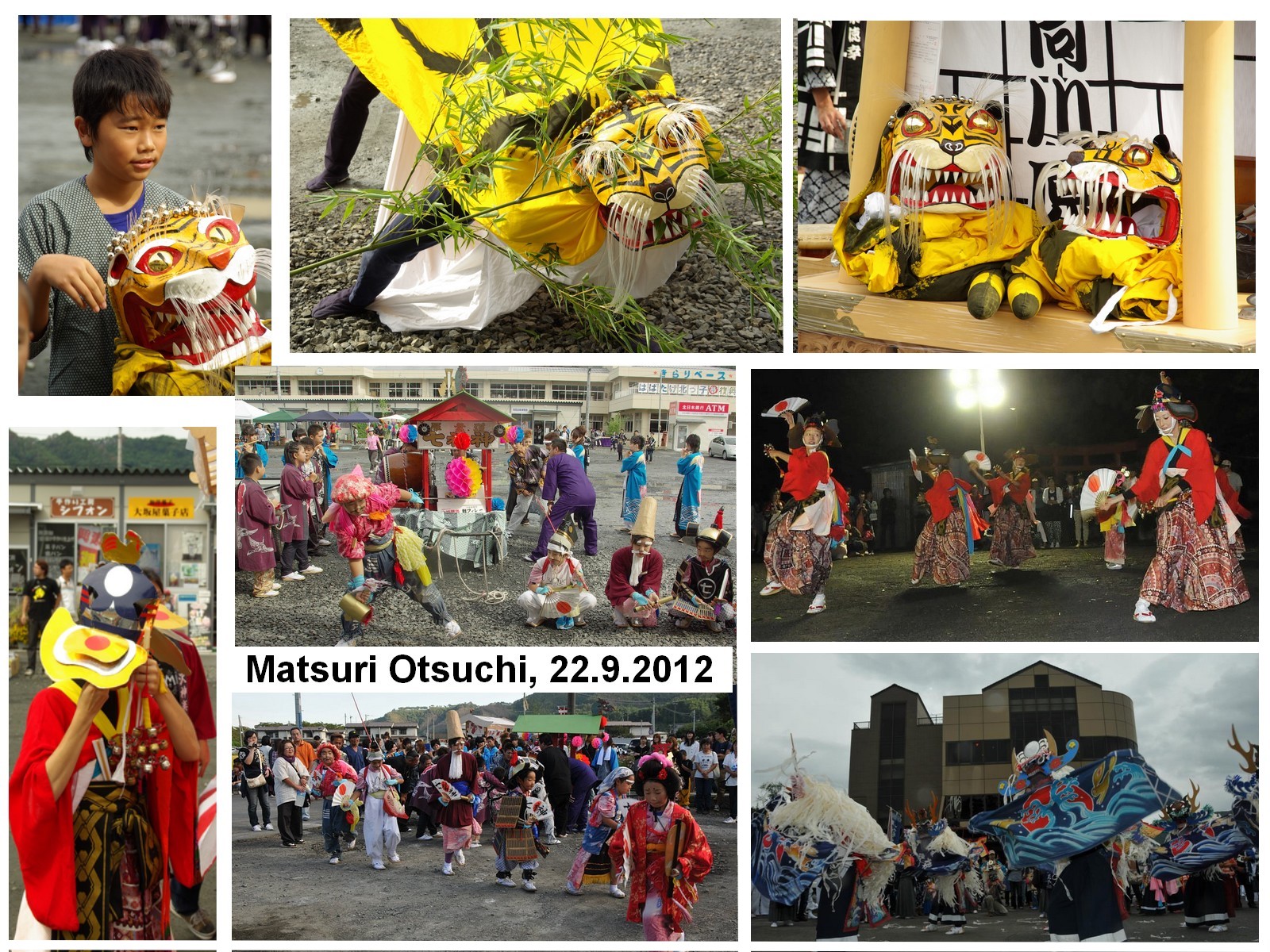
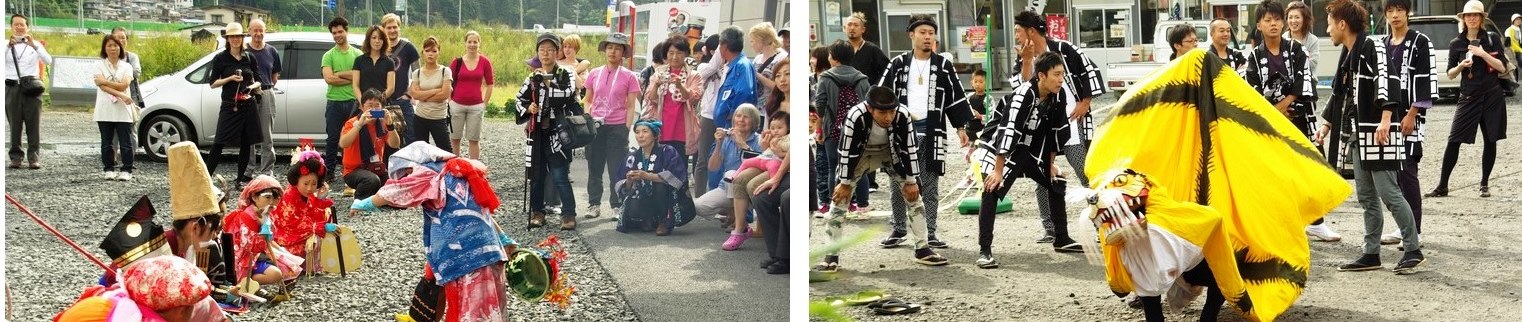
それに大槌町には郷土芸能団体が19団体あります。神楽であったり、虎舞であったり、獅子踊りであったり、七福神であったり、さまざまな団体が現在も活動しています。
こんな小さな町で、こんなにも多くの郷土芸能がある町ってなかなかないですよね。
歴史的にも古い土地で、香り高い文化のある町だと思います。人情味があり、心の優しい人がたくさんいる、そんな町ではないかなと感じます。

ワードプレス用

―震災直後から今まで、大槌町を含め被災地域で活動しているボランティアがたくさんいます。
ボランティアの活動を見て、どのように思いますか?また、4年が経過する今、ボランティアに行く意味があるのかという声もあります。
町長はどのように考えますか?

震災当時も今も心から感謝の気持ちでいっぱいです。
震災直後からの復旧期には全国からたくさんの方々が駆けつけて下さり、本当に助かりました。一方で、震災後3年4年と過ぎてくる中で、ボランティアも減り、震災が風化し始めているのは当然のことだと思います。
復旧期にはガレキ処理や泥の片づけなどマンパワーが必要な作業が多く、始めはボランティアに頼る部分もかなりありました。
でも今は、作業として業者の担う大きい工事が進められている状況にあります。
橋や道路を作る仕事などは、当然ボランティアじゃできません。そのかわり、復興のソフト面ともいえる住民の心のケア、例えば、応急仮設住宅の暮らしが長い皆さんを勇気づけるような存在、心の拠り所となり、被災地を励ます役割を担ってもらえるのではないかと思います。
私はいつも、「私たちはいつも大槌にいるので、来てくれるだけでありがたいです。」という話をします。そして大槌で買い物をして、ご飯を食べて、励ましてくれる、それだけでいいのです。大槌に来て感じた魅力についてほかの人へ発信してもらえれば、さらに嬉しいことです。
そして、例えば手紙などで交流が続くような大槌との繋がりを持っていただき、リピーターとなって足を運んで、長い目で復興を見守ってもらえたらありがたいですね。

―では最後に、現役の大学生や高校生に向けてのメッセ―ジをお願いします。

被災地を訪れたことのない学生は、一度来てみるべきだと感じています。
大槌は全人口の一割の方が亡くなり、いま、ゼロからのまちづくりをしています。多くの学生は、これから人生の中で、楽しいことだけでなく、様々な苦しみ悲しみにも遭遇するでしょう。
今、現実にこれほどの苦しみや悲しみに遭いながらも、再び立ち上がろうとするこの町の様子を目にし、ここに生きる人々の決意や明るさに触れることによって、視野が少し変わったり、自分を少し成長させることができたりするのではないかと思います。

http://youthfor311.com/interview-for-3-11-vol-3/

POINT OF VIEW/ Yuko Endo: 4 years from nuclear disaster, Fukushima needs to reverse depopulation

Interview mit dem Bürgermeister von Kawauchimura, Herrn Yuko Endo

March 19, 2015

Mayor Yuko Endo listens to proposals for post-quake reconstruction from elementary school pupils in Kawauchi, Fukushima Prefecture, in November. (Susumu Okamoto)

Kawauchi Mayor Yuko Endo during a recent interview (Susumu Okamoto)

Mayor Yuko Endo listens to proposals for post-quake reconstruction from elementary school pupils in Kawauchi, Fukushima Prefecture, in November. (Susumu Okamoto)

Mayor Yuko Endo listens to proposals for post-quake reconstruction from elementary school pupils in Kawauchi, Fukushima Prefecture, in November. (Susumu Okamoto)

THE ASAHI SHIMBUN

The village of Kawauchi, where I serve as mayor, is located 20 to 30 kilometers southwest of the crippled Fukushima No. 1 nuclear power plant.

Radiation levels remained relatively low, so it was quite obvious what we had to do to allow residents to return. We attracted firms to secure workplaces, and we expanded the lineup of departments at our clinic so residents could live with peace of mind once they returned.

We also plan to open an intensive care home for the elderly and a shopping complex by year-end.

Of the 3,000 or so people who lived in Kawauchi before the nuclear disaster, some 1,600 have so far returned. Only 20 percent of those aged 40 or under are back in Kawauchi.

Families are no longer the same as before. As they have had to live in evacuation, such as in temporary housing, the number of households has increased from the pre-disaster figures of 1,100 to 1,500.

Young villagers have landed jobs in urban areas, where they took shelter. Children have also gotten used to schools to which they were transferred. Those people are building new lives for themselves, although we call them “evacuees.”

They have come to think of returning to their own homes as something like a “resettlement” because a return to Kawauchi would require them to once again drastically alter their living environment.

I think it is no longer possible to restore the village to what it was. There is nothing wrong with people’s decisions to settle elsewhere in a forward-looking mindset, instead of returning to Kawauchi. In fact, continuing on with an “all-temporary” life–a temporary job and a temporary school–would be akin to wasting precious time in your life.

The central government has set aside 25 trillion yen ($208 billion) to spend on rebuilding efforts from the Great East Japan Earthquake, tsunami and nuclear disaster during a five-year “intensive reconstruction period.” That period will expire at the end of fiscal 2015.

The central government intends to show the world how Fukushima has been rebuilt, hopefully when the Summer Olympics are held in Tokyo in 2020.

I think it is, of course, essential to designate a deadline in setting a goal, but I don’t want it to be forgotten that it takes a long time to rebuild a disaster-hit area.

Forests, which account for 87 percent of Kawauchi’s landmass, have yet to be decontaminated. All we can do is wait for the natural decay of radioactive substances while taking care of the forests, but that will probably take us something like 40 years, the same time frame for having the nuclear reactors decommissioned.

I am concerned that when the “deadline” has passed, the central government could reduce its assistance in the name of efficiency across the entire area of Futaba county (a broader administrative district that includes Kawauchi), which hosts the Fukushima No. 1 nuclear plant.

Rebuilding measures are, of course, essential, but rather, how to cope with an ongoing depopulation is, in fact, presenting an extremely crucial issue. Kawauchi’s current population of 1,600 had initially been projected for some time around 2030. But the nuclear disaster has abruptly turned that projection into a reality.

Other constituent towns and villages of Futaba county, where a return of residents will get under way from now on, will also have to face the same challenge. Without young people, it remains difficult to manage a local government and envisage a future for a local community, no matter how magnificent the infrastructure to be built under reconstruction measures.

I realize that exactly represents the serious nature of the nuclear disaster.

While it is never easy to try to stop depopulation, an anxiety about not knowing how we could cope with the drastic change we are now facing is giving the villagers a sense of loss and helplessness, which is working against their return.

I want the central government to offer tax incentives and other measures so people will feel they would be better off working in the countryside than doing so in an urban area.

If the central government says it cares about provincial communities and wants to revitalize their economies, why not decentralize the organizations and human resources of the national government, which are centered in Tokyo, to rural areas? Young people will never join depopulated communities from the outside unless there are policy incentives such as those.

Unlike in natural disasters, it is obvious to see who are responsible for and who were victimized by the nuclear disaster. That situation, in my view, is preventing disaster-hit communities from standing on their own feet and is making them unhappy in the end.

Damage should be repaired properly, but thinking of yourself forever as a victim will probably not allow you to proceed to the next stage of the rebuilding process, whereby you should build a new community on your own.

The rice-planting area in Kawauchi rebounded to about 160 hectares last year, half as large as pre-disaster levels. That is because so many farmers find joy and take pride in farming in the village. In the part of Kawauchi where evacuation orders were lifted in October, young farmers are trying to grow gentians, which they hope to turn into a new special product.

I feel so reassured to learn that some of our residents are showing their mettle at a time when the overall population is increasingly relying on administrative services.

It is not cash but human resources that have the potential to change a local community.

Rebuilding Kawauchi could also help assist those who have left our village. They do need a home community to which they could return whenever they wish to. That would require persevering efforts, but we cannot afford to give up on them.

* * *

Born in 1955, Yuko Endo, mayor of Kawauchi since 2004, previously served on the village assembly there. While almost all residents of Kawauchi evacuated following the Fukushima nuclear disaster of March 2011, Endo issued a message to them in January 2012, in which he called on those who could to return to the village.

(This article is based on an interview by Susumu Okamoto.)

Japanese Coastal Town Still Struggling to Rebuild From 2011 Tsunami – Otsuchi

Many of the survivors of the tsunami that devastated Otsuchi, Japan, four years ago live in temporary housing like these prefabricated units on school property. Ko Sasaki for The New York Times

OTSUCHI, Japan — The spot where the town’s center once stood is now a dusty construction site filled with diggers and dump trucks toiling amid huge, man-made mesas of earth and gravel. The work is part of an $850 million project to elevate the land by seven feet and shield it behind a towering 48-foot wall.

Four years after a colossal tsunami swept away most of this remote fishing community on Japan’s mountainous northeastern coast, Otsuchi is starting to rebuild.

However, the wait is far from over for thousands of the town’s survivors, many of them still living in temporary apartments after being left homeless by the waves. Otsuchi was so severely crippled by the calamity — 1,284 people died here, including the mayor and many town hall employees, firefighters and police officers — that the town struggled for years even to put together a recovery plan. Reconstruction began only last year and will not be finished until at least 2019, the new mayor says.

Similar stories could be heard across Japan’s tsunami-struck northeast as the nation held prayer ceremonies this week to observe the anniversary of the magnitude 9.0 earthquake and resulting tsunami on March 11, 2011, that left 18,490 people dead or missing. Almost 250,000 people lost their homes in the calamity, and 87,000 still live in cramped, prefabricated housing that was originally meant to last for just two or three years.

Hiromi Kawaguchi, in his two-room apartment in emergency housing, lost his mother, wife and 4-year-old grandson. “We are still very much a disaster zone,” he said.CreditKo Sasaki for The New York Times

It is not clear when, if ever, they will move back. In Fukushima, where the tsunami caused meltdowns that destroyed the Fukushima Daiichi nuclear plant, some areas were so contaminated with radiation that they may not be habitable for decades.

In small coastal communities farther north like Otsuchi, far enough away to escape most of the nuclear fallout, many survivors have simply given up and moved elsewhere, accelerating the depopulation of rural areas in this rapidly graying nation. Those who want to stay worry they could face additional waits as memories of the tragedy fade in the rest of Japan, where attention is now turning to events like the 2020 Olympics in Tokyo.

“Everyone seems to think that life has gone back to normal here, but we are still very much a disaster zone,” said Hiromi Kawaguchi, 66, a retired town employee who lives alone in a tiny two-room apartment in refugee housing after losing his wife, mother and 4-year-old grandson, Shoya, to the tsunami.

“Does this mean more delays if the nation has lost its sense of urgency about us?” he said. “Even big construction companies are starting to leave to get a piece of the Olympics.”

To help in the rebuilding, the central government in Tokyo pledged 25 trillion yen, or about $206 billion, to pay for reconstruction and radiation cleanup as part of a “concentrated recovery program” that was supposed to end in 2016. However, local governments have been so overwhelmed by the task of rebuilding that many have fallen behind schedule and proved unable to even spend all the recovery money made available to them.

Otsuchi is a case in point. Once a quiet community of 15,200 residents on a picturesque bay between rugged mountains and the Pacific Ocean, Otsuchi was struck by seething 50-foot waves that destroyed more than 80 percent of the town’s structures, including the town hall, fire department, police station and main hospital. The tsunami killed the mayor and almost 50 town employees, leaving Otsuchi leaderless in the months after the disaster.

“The town was paralyzed by the chaos,” Otsuchi’s new mayor, Yutaka Ikarigawa, said in an interview in the temporary town hall, which occupies a former elementary school that was damaged in the disaster.

Survivors said it took a year to erect temporary housing and supply all the units with electricity and water; the cleanup of a half-million tons of crumpled cars, shattered wooden beams and other debris was completed only last year.

Survivors also struggled to reach a consensus on what they wanted their reconstructed town to look like. Some favored the huge, expensive wave walls that officials in Tokyo urged them to build. Others pointed out that such walls had failed to save residents in other towns. They argued that the safest thing to do would be completely rebuild the town on higher ground.

In the end, the town settled on a compromise in which commercial structures like factories and stores would be rebuilt on the site of the old town center, which would be elevated and protected behind a wall as wide as half a football field at its base. Most residents will move to new housing at higher elevations, including on flattened hilltops.

Today, the neighborhoods that had been left in ruins are being covered by thick layers of fresh soil. The three-story concrete town hall, its insides gutted by the tsunami that almost completely submerged it, is the only building left standing in the town center. Buddhist statues have been placed in front, turning it into a memorial for those who perished inside.

11042674_390780241100923_6507396406204601769_n10835327_931128936920000_5601280162802526729_o 10830474_905080749524819_5471514793678430661_o 10978607_769814343111265_3170556911701049306_n 10930999_782863438435638_1676503939248368497_o

But the start of construction has brought new delays. Otsuchi has struggled to find construction companies to even bid on its contracts, as a boom in post-tsunami rebuilding has created a shortage of contractors. That shortage has been made worse by Olympic-related construction projects in Tokyo, said the mayor, Mr. Ikarigawa.

As a result, Otsuchi has been unable to spend all the money allocated to its recovery by the central government. In 2012, Otsuchi was able to spend just 28 percent of the $178 million made available to it. Last year, with a new reconstruction plan finally in hand, it did better, spending 62 percent, Mr. Ikarigawa said.

“It doesn’t make sense to have to return unused recovery funds when so much of the town still needs rebuilding,” said Keiichi Sasaki, 53, the head of a neighborhood committee in Otsuchi whose home was washed away by the tsunami.

Until their homes can be rebuilt, about 3,700 residents live in temporary housing, waiting. Thousands of others have already given up: The town hall estimates that Otsuchi has lost at least a quarter of its population to the disaster and the exodus that followed.

Mr. Kawaguchi, the retired town employee, said the number who left may be even higher. He said many lost hope after the construction boom started to drive up the cost of labor and building materials, making it more than twice as expensive to rebuild now as just two years ago.

Nor has the central government provided much relief: It offers subsidies of $40,000 to $60,000 to help rebuild homes that now cost $300,000 to $450,000 to rebuild.

“The country has no problem putting huge sums into big public works projects like wave walls, but it won’t help average people,” Mr. Kawaguchi said. “The longer it takes to recover, the more our town will wither away.”

Schwester Caelina berichtet über Erdbeben in Japan: Immense Katastrophe

Westfälische Nachrichten: Do., 09.10.2014

Fujinosono 2

Schwester Caelina  (Christa Mauer) Foto: —

Lengerich – 

Den 11. März 2011 wird Schwester Caelina wohl nie mehr vergessen. Es war der Tag, an dem Japan von einem starken Erdbeben und einem Tsunami heimgesucht wurde. Es war der Tag, an dem die Katastrophe von Fukushima ausgelöst wurde. Die Franziskanerin erlebte ihn hautnah mit.
Schwester Caelina verbringt zurzeit einen Heimaturlaub im Mutterhaus in Thuine. Sie stammt aus Heede und trat 1984 in die Kongregation der Franziskanerinnen ein. Seit 20 Jahren ist sie in Japan tätig, seit 2009 leitet sie das Kinderheim Fujinosono.„Stehen Sie auf, stellen Sie sich breitbeinig fest auf ihre Füße. Und stellen Sie sich vor, der Boden unter ihnen schaukelt so heftig, dass Sie sich nicht mehr auf den Füßen halten können.“ Sehr anschaulich vermittelt Schwester Caelina ihren Zuhörerinnen, wie es sich anfühlt, wenn die Erde bebt. Die Franziskanerin berichtete den kfd-Frauen von St. Margareta am Dienstag von der Katastrophe, die am 11. März 2011 Japan heimsuchte – und unter anderem das Kinderheim Fujinosono in Ichinoseki zerstörte. Den Hilferuf aus Fernost hörte damals auch die katholische Kirchengemeinde in Lengerich, die eine Spendenaktion für die Einrichtung initiierte.

60 Schützlinge im Alter von zwei bis 18 Jahren leben dort. Es gibt eine Mädchen-, eine Jungen- und eine Gruppe mit Kleinkindern. Die jungen Bewohner werden vom Jugendamt vermittelt. 60 Prozent seien misshandelt worden, berichtet Schwester Caelina, oft seien sie auch verwahrlost. Etwa zehn Prozent seien Waisen, teilweise seien die Eltern aber auch einfach verschwunden. Fast alle Kinder litten unter der Tatsache, dass man sie verlassen hat, manche seien psychisch krank.

Obwohl Fujinosono ein christliches Heim ist, sei keines der Kinder getauft, erklärt die Schwester. Unter den Mitarbeiterinnen sei auch nur eine Katholikin, aber alle akzeptierten die christlichen Leitlinien. Mit 18 Jahren würden die Jungen und Mädchen das Heim verlassen und ins Arbeitsleben starten. Ein Studium sei zu teuer.

Ein Schauer lief den Zuhörerinnen über den Rücken, als Schwester Caelina über den schicksalhaften 11. März 2011 berichtet. Das Erdbeben sei ohne Vorwarnung gekommen. Sie hätten sich unter Tischen verkrochen. „Ich dachte wirklich, meine Sterbestunde wäre gekommen“, erinnert sich die Franziskanerin. Als sich das Beben abschwächte, habe man alle Heimbewohner evakuiert und sie in der Turnhalle untergebracht, da das Heim einsturzgefährdet war. „Die Kinder waren teilweise wie erstarrt. Wir mussten sie herausschleppen“, erzählt die Schwester. Das Haus habe geschwankt, die Erde sei aufgerissen, breite Spalten hätten sich gebildet.

Mehrere Tage hatten die Bewohner keinen Kontakt zur Außenwelt. Sie mussten auch ohne Wasser, Strom und Telefon auskommen. Die Notrationen an Nahrung hätten für die über 100 Personen nur einen Tag ausgereicht. An Nachschub war nicht zu denken. Zum Glück habe man wegen des Frostes die Lebensmittel haltbar machen und strecken können. Nach einer Woche habe sich dann ein Bäcker gemeldet, der sein Brot ohne Kühlung nicht länger halten konnte. „So konnten wir den Kindern wenigstens ein Frühstück bieten“, erzählt die Schwester. In den ersten vier Wochen habe man keine Eiweißprodukte für die Kinder bekommen können. Schlimm sei die Panik der Kinder bei den Nachbeben gewesen. Sie hätten sich an die Betreuerinnen geklammert und nicht mehr loslassen wollen.

Zehn Tage habe es gedauert, bis man vom Ausmaß des Unglücks in Fukushima gehört habe, berichtete Schwester Caelina weiter. Die Nerven der Erwachsenen seien mehr als angespannt gewesen. Als dann in Ichinoseki, gelegen im Norden der Hauptinsel Honshu, zwischen Steinbrocken und Schnee erste Krokusse den Frühling verkündet hätten, habe man das fast wie ein Versprechen gesehen, eine Hoffnung auf „Auferstehung“.

Behördenvertreter wie auch Leute von anderen Kinderheimen seien gekommen, um sich ein Bild von der Zerstörung zu machen. Nach ersten Reparaturen seien Kinder und Betreuerinnen nach einer Woche Turnhalle wieder in die „Notunterkunft“ Waisenheim gezogen. Da das Gebäude nicht für eine dauerhafte Nutzung hergerichtet werden konnte, begann die Planung für einen Neubau. Das erste Modell wurde mit zwölf Millionen Euro Kosten veranschlagt. Eine Summe, die auf keinen Fall aufgebracht werden konnte. Daher musste eine einfachere Lösung her, die aber doch auch die Auflagen der Behörden (größer, erdbebensicher) berücksichtigte. Auf dem Baseballplatz des Heimes entstand ein Containerdorf. Das alte Heim wurde abgebrochen. „Ein trauriges Erlebnis für Kinder und Betreuerinnen, da das Gebäude ja lange Zeit Zuhause war“, führt Caelina an.

Die Schwester zeigte Bilder von Festen und Veranstaltungen, die den Wiederaufbau begleiteten und die Kinder wieder in den Alltag eingliedern sollten. So wurde der Jahrestag der Katastrophe besonders begangen. Der Neubau des Heimes sei von 27 Ländern unterstützt worden, berichtet die Schwester, die immer wieder die große Hilfe von Malteser International hervorhebt.

Bis Mitte November ist Schwester Caelina noch im Mutterhaus in Thuine, bevor sie dann wieder nach Japan zurückkehrt.

http://www.wn.de/Muensterland/Kreis-Steinfurt/Lengerich/1751696-Schwester-berichtet-ueber-Erdbeben-in-Japan-Immense-Katastrophe

„Ode an die Freude“ als Dank für die Fukushima-Spender

Hamburger Abendblatt:  DI, 17.03.15, 05.01

HAMBURG 068

Ilja Stephan

Hamburg. Aus Anlass des vierten Jahrestages der Katastrophe von Fukushima und als Dank an alle, die für den Wiederaufbau gespendet haben, lud das japanische Konsulat am Sonntag zu einem großen Festkonzert. Im bis zum letzten Platz gefüllten Rolf-Liebermann-Studio des NDR erklang ein teils besinnliches, teils festliches Programm mit Ausschnitten aus Mozarts Requiem, Konzertsätzen von Grieg und Mendelssohn sowie dem Klassiker universeller Verbrüderung: Beethovens „Ode an die Freude“.

Der Mensch könne mitunter zwar „extrem grausam sein“, gab Konsul Yasushi Fukagawa in seiner Ansprache zu bedenken, er könne aber auch Gutes tun und daran seine Freude haben. Und in diesem Sinne hatte man das Event unter das japanisch-höfliche Motto „Ihre Freude ist unsere Freude“ gestellt. Einen Überblick über die Projekte, die dank der Spendengelder realisiert werden konnten, gab Gesa Neuert, die langjährige Vizepräsidentin des Verbandes Deutsch-Japanischer Gesellschaften. Neuert berichtete von mehreren Niedrigenergiehäusern, die als Versammlungsstätten für die durch die Evakuierungen zersprengten Dorfgemeinschaften gebaut worden seien.

Für Musikliebhaber war es eine besondere Freude, dem Dirigenten Kazuo Kanemaki zuzuschauen, wie er sein riesiges Freiwilligenensemble durch das anspruchsvolle Programm lotste. Drei Hamburger Laienchöre und ein komplettes Symphonieorchester hatte der Leiter des Hamburger Polizeichores zusammengetrommelt. Hinzu kamen Solisten von den Berliner Philharmonikern und dem Opernhaus Kiel. Man hat wohl nur selten eine Aufführung von Beethovens monumentalem Freudenchor gehört, die so gut zu ihrem Anlass gepasst hätte. Ihre Freude war unsere Freude. Arigatou gozaimasu.

Programm

„Ihre Freude ist meine Freude“ – Sonntag, 15. März 2015 um 15.00 Uhr

„Dies irae“ aus dem Requiem Wolfgang Amadeus Mozart

Begrüßung: Yasushi Fukagawa Konsul und Leiter des Konsulats von Japan in Hamburg „Lacrimosa“ aus dem Requiem Wolfgang Amadeus Mozart

Op. 16 1. Satz Edward Grieg Klavier: Eiko Okuno-Jürgensen Symphonie Nr. 7 Op. 92 2. Satz Ludwig van Beethoven

Pause

Bericht zur aktuellen Lage in der Katastrophenregion: Gesa Neuert,  Vorsitzende des Deutsch Japanischen Synergie Forums Sanriku Fukkou e.V.

Vortrag Hamburg Gesa Neuert final

„Haru no umi“ (Meer des Frühlings) – Michio Miyagi Solo-Flöte: Yumi Iizawa Klavier: Makiko Eguchi Klavierkonzert

Violinkonzert Op. 64 1. Satz Felix Mendelssohn-Bartholdy – Violine: Marlene Ito (Berliner Philharmoniker)

Symphonien Nr. 9 Op. 125 4. Satz, „Ode an die Freude“ Ludwig van Beethoven       Sopran: Shihoko Kondo  –   Alt: Hitomi Kawai   –   Tenor: Yuta Sato   –  Bass: Tomohiro Takada (Opernhaus Kiel),    Mitwirkende des Konzertes: Johannes-Brahms-Chor Hamburg, Kanemaki-Chor-Hamburg e.V., Chorensemble Goethe

Dirigenten: Masanori Hosaka und Kazuo Kanemaki

Hamburger Abendblatt: DO, 12.03.15, 05.01

KONZERT  – Tsunami in Japan: Hamburger spenden 280.000 Euro

Ralf Nehmzow

Die Tsunami-Welle nach dem Erdbeben in Japan im März 2011

Mit einem Konzert für 400 geladene Gäste will sich der Leiter des Konsulats von Japan in Hamburg am 15. März bei den Spendern bedanken.

Hamburg.  Am 11. März 2011 erschütterte eine gigantische Katastrophe mit Erdbeben, Tsunami und Störfällen im Atomreaktor den Nordosten Japans. Viele Hamburger nahmen daran Anteil. Institutionen und Privatpersonen spendeten unter dem Motto: „Hamburger Bürger helfen Japan“. Mit einem Konzert für 400 geladene Gäste, darunter ehrenamtliche Helfer, will sich Yasushi Fukagawa, Leiter des Konsulats von Japan in Hamburg, am 15. März 2015 um 15 Uhr im Rolf-Liebermann-Studio des NDR an der Oberstraße bei den Spendern bedanken.

„Es gab rund 150 Veranstaltungen im Amtsbereich des Konsulats; die Spendenbereitschaft und das Engagement der Hamburger waren wirklich unglaublich“, sagt der Konsul. 50 Musiker, Profis und Studierende, werden für das Konzert ein eigenes Sinfonieorchester zusammenstellen unter der Leitung des Dirigenten Kazuo Kanemaki, der unlängst von Bundespräsident Joachim Gauck ausgezeichnet wurde. Hinzu kommen 70 Sänger aus drei Chören.

Interessierte können Restkarten bekommen, Anfragen bitte per Mail an: hh-konsulat@bo.mofa.go.jp, Infos auch unter 333 01 70. In Hamburg gab es damals eine große Lichterkette, Schulen veranstalteten Benefizkonzerte, Jugendliche organisierten Basare, Sportvereine sammelten Geld bei Wettbewerben. Deutschlandweit spendeten Unternehmen und Privatpersonen kleine und große Geldsummen auf die Konten der Deutsch-Japanischen Gesellschaft.

Die Bilanz: Bis heute konnte sie rund 280.000 Euro über die deutsche Botschaft in Tokio und einen eigens gegründeten Hilfsfonds nach Japan übermitteln, inklusive rund 40.000 Euro, die die Deutsch-Japanische Juristenvereinigung gesammelt hatte.

Death toll grows in 3/11 aftermath

In den letzten 4 Jahren hat es viele Selbstmorde, die im Zusammenhang mit der Katastrophe stehen, gegeben. Die meisten Betroffenen stammten aus Fukushima.

1966336_745861182098191_979723776_o

FUKUSHIMA MINPO

The number of nuclear evacuees dying from deteriorating health caused by refugee life is still growing even though four years have passed since the unprecedented calamity that struck on March 11, 2011.

As of March 4, the deaths of 1,867 people in Fukushima Prefecture had been recognized as related to the earthquake, tsunami and nuclear crisis, surpassing the 1,603 who are deemed to have been killed there directly by the quake and tsunami.

Nearly 120,000 people in the prefecture are still living as evacuees, stuck in stressful environments.

Among the three prefectures hit hardest— Fukushima, Iwate and Miyagi — Fukushima has a particularly high “disaster-related death” ratio of 54 percent compared with “direct deaths.” By municipality, Minamisoma led with 469 related deaths, followed by Namie at 342, Tomioka at 291, and Iwaki at 130.

In Iwate and Miyagi, by contrast, the ratio of disaster-related deaths is only around 9 percent for each. Iwate had 450 related deaths versus 4,672 direct deaths, while Miyagi had 909 and 9,621, respectively.

Many suicides have been reported in Fukushima amid the growing despair caused by the prolonged evacuation.

A death is recognized as disaster-related if it is deemed by a panel of doctors, lawyers and other experts to have a causal relationship with the quake, tsunami or nuclear disaster.

For each such death, ¥5 million in condolence money is paid to the family’s main breadwinner, and ¥2.5 million to others.

But objections from relatives of dead people who are not recognized as disaster victims by the panel are rising as the evacuation drags on.

According to Fukushima Minpo’s tally of data from 24 municipalities, there have been at least 46 objections, including 19 in Iwaki and 13 in Minamisoma.

Lawyers say the kin of those not recognized are frustrated because there are no clear standards for determining who should be recognized as having died from disaster-related causes. They fear that the number of objections filed will increase as it will be even more difficult to prove a causal relationship between a death and a disaster as time passes.

Some are calling for setting up a mechanism to pay out condolence money specifically for deaths related to stress caused by the nuclear disaster.

Meanwhile, municipalities hosting large numbers of evacuees are improving efforts to visit residents in temporary housing to check on their health.

As of the end of January, about 14,600 people from the town of Namie were still living in temporary housing in the prefecture, while some 6,400 others were living as evacuees elsewhere.

Twenty-five counselors from the Namie municipal welfare office are making routine visits to such housing units to check on people living alone so solitary deaths can be prevented.

The town has also placed 30 staff in 10 prefectures around the country, including Kyoto and Fukuoka, to provide support for residents who fled Fukushima.

The staff visit the homes of such people individually and listen to them to ease the loneliness of living far away from home.

They also hold gatherings for the evacuees so they can socialize and talk with one another. In Chiba Prefecture, such efforts have led to residents themselves holding tea parties for displaced people in the neighborhood.

“It’s difficult to look after people scattered around in such a vast area, but we want to continue providing support for each and every one of them,” said one of the Namie welfare office staff.

In Minamisoma, prefectural officials and the municipal welfare office staff work as a team on home visits.

Prefectural officials make the rounds of temporary housing units on weekdays, while the welfare office staffers pay daily visits to both temporary and rented units, as well as to permanent public housing units for evacuees.

The city and Minamisoma police have also set up a “three-day rule” under which welfare staff report to the city and police if no physical meeting is reported for three days from residents of the homes they visit.

The rule was established after a number of elderly living alone were found dead last spring, sometimes days or weeks after the fact.

While some initially felt the frequent visits were intrusions, others began making their own rounds to check on neighbors, municipal officials said.

The city and police have also established a network with newspaper and milk delivery personnel to routinely check on the elderly.

In November, a milk delivery person found an elderly woman collapsed in a public housing unit, saving her life.

This section, appearing every third Monday, focuses on topics and issues covered by the Fukushima Minpo, the largest newspaper in Fukushima Prefecture. The original article was published March 5.

http://www.japantimes.co.jp/news/2015/03/15/national/death-toll-grows-in-311-aftermath/#.VQdOF46G82u

The gigant Seawalls in Japan

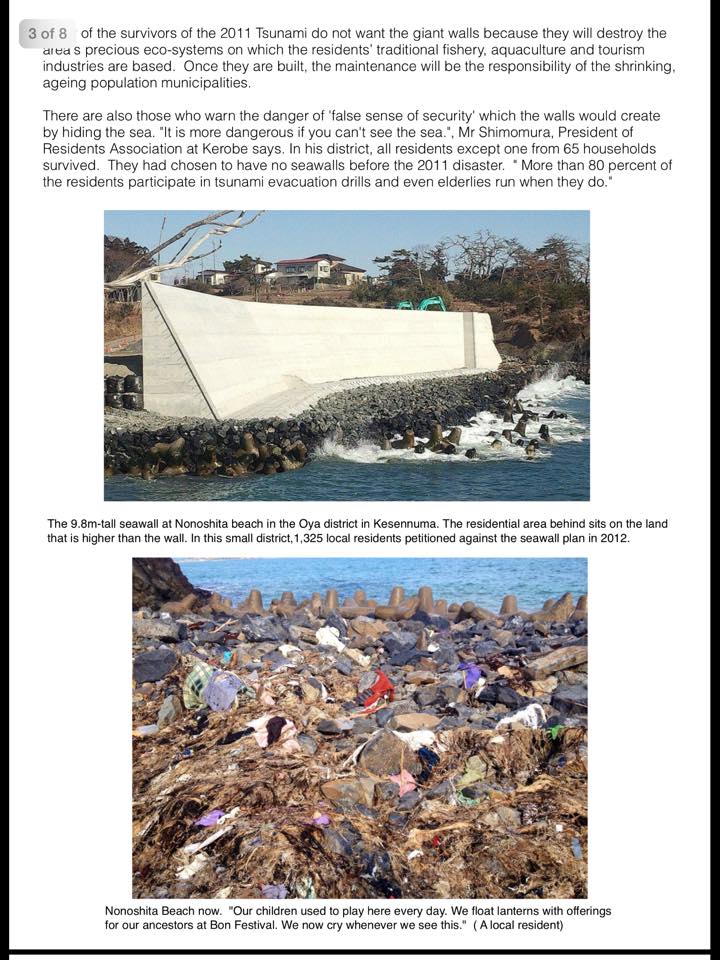
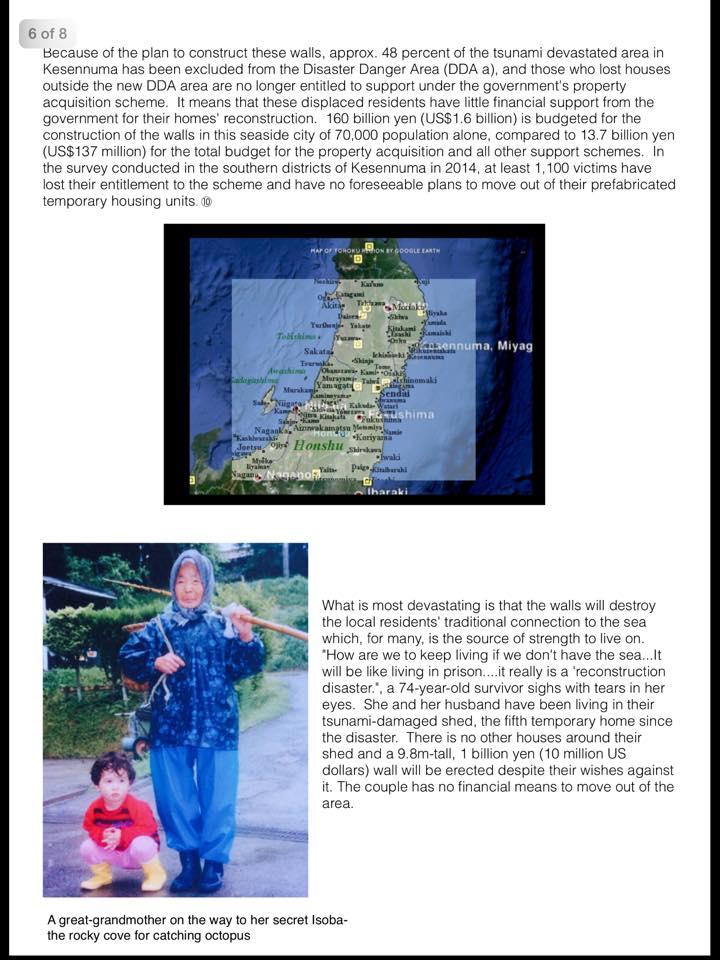
(Please share!) So this is the Japanese government’s controversial giant seawall plan: 400km-long, up to 50ft ( 15m) tall, as wide as 90m at foundation, concrete seawalls (dykes), which will be built on more than 400 beaches, lagoons and rocky coves of Tohoku Rias Coasts National Park.

It is part of the 200 trillion-yen National Resilinece Policy to ‚protect lives and assets‘ from tsunamis of every 50-150 years. In kesennuma, nearly half of those locations have ZERO to a few residential houses in the area the walls supposedly protect. What would be its environmental effects? What would it do to the local traditional livelihoods of fishery and tourism? What happened to the lessons learnt from the 229-death toll among 3000 affected households of ‚Superwall‘ Taro city, compared to 65 deaths out of 3200 affected households of Kuwagasaki where there were no walls.

The planned walls are about half the size of the 2011 tsunami and if there is a tsunami that is ‚unexpectedly large“, the officials say ‚please run‘. How do the residents confidently judge whether or not/ when to run? In Kesennuma, Approx. half of the displaced residents lost their entitlement to the government’s buy-out scheme because their properties are no longer designated as the Disaster Hazard Zone. In Tagajo, it is 100%! They would no longer be able relocate to higher ground, let alone moving out of their temporary units. Please help us stop this plan by spreading the petition below. Thank you for your help!

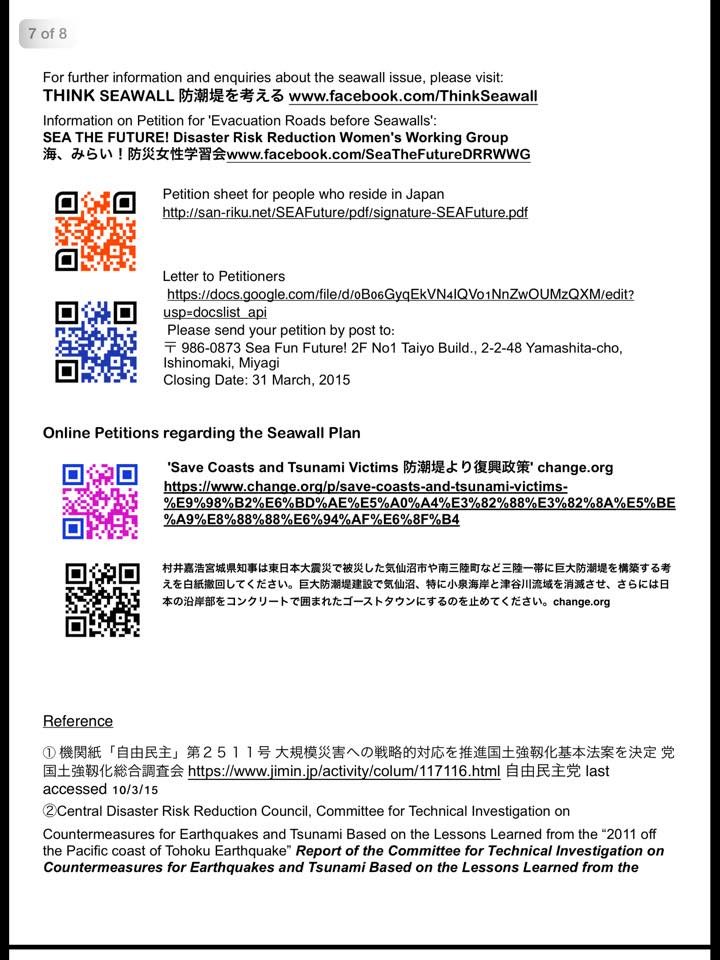
Online Petition

‚Save Coasts and Tsunami Victims 防潮堤より復興政策‘ change.org
https://www.change.org/p/save-coasts-and-tsunami-victims-%E…

Best regards, Hiroko Otsuka
10401996_785247331565151_2204606570309289008_n - Kopie11045420_785247348231816_3808900166252708529_n - Kopie11037282_785247361565148_2535909664434264271_n1622691_785247388231812_4684289312659021276_n1508573_785247408231810_3768238072433961211_n10994637_785247468231804_1597564999293579120_n11025624_785247481565136_1331434468184931851_n11046219_426884177466223_7913935031998863808_n

Japans Ex-Premier zu Fukushima“Fünf Tage am Randes des Abgrunds“

„Fünf Tage am Randes des Abgrunds“

12. März 2015, 18:38 Uhr

Als vor vier Jahren das Atomkraftwerk von Fukushima explodierte, war Naoto Kan Regierungschef in Japan. Im Interview mit dem stern spricht er über die Stunden nahe der Apokalypse.

Fukushima, Japan, AKW, GAU, Atomkraft, Tepco, Naoto KanNaoto Kan, 69, war 15 Monate Premierminister Japans. In seine Amtszeit fiel der GAU von Fukushima© Takehiko Kambayashi/DPA

Angesichts der unvorstellbaren Katastrophe von Fukushimavon „einer Menge glücklicher Zufälle“ zu sprechen, klingt gewagt – doch Naoto Kan tut es. Vermutlich sollte man ihm das auch glauben, denn Kan war vor vier Jahren, als ein Erdbeben und ein Tsunami die Reaktoren verwüstete, japanischer Ministerpräsident und damit politisch verantwortlich für die Folgen des GAUs. Und angesichts der Ereignisse mittlerweile ein erklärter Gegner der Atomkraft. Einer der glücklichen Zufälle etwa sei es gewesen, dass der Reaktor 1 nicht in die Luft flog, wie zu befürchten war, sagt er im Interview mit dem stern. Und doch: „Fünf Tage standen wir damals am Abgrund. Vielleicht hat uns Gott vor dem Schlimmsten bewahrt“, so Kan.

Noch heute, vier Jahre nach der Katastrophe von Fukushima, ist Japans Ex-Regierungschef erschüttert, wenn er über die Tage am Rande der Apokalypse redet. Es gab damals keinen Plan, bis zu 50 Millionen Menschen im Großraum der japanischen Hauptstadt zu evakuieren. „Darüber konnte ich natürlich nicht offen sprechen“, sagt Kan. Geholfen, das allerschlimmste zu verhindern, hatte am Ende der Chef des Kraftwerks, der sich, unüblich für die japanische Unternehmenskultur, über die Anordnungen seiner Chefs hinweggesetzt hatte. „Das war Teil seiner Verantwortung und entsprach seiner Persönlichkeit“, so Kan.

„Bei Tepco herrschte Chaos“

In den Tagen als das Unglück seinen Lauf nahm, standen wegen der offenkundigen Schwierigkeiten, den GAU noch irgendwie zu verhindern, sowohl die Regierung in Tokio als auch die Betreiberfirma des Kraftwerks Tepco massiv in der Kritik. Naoto Kan sagt im Nachhinein, dass bis heute nicht klar sei, wer damals eigentlich für was verantwortlich gewesen sei. „Bei Tepco herrschte Chaos, die Leute vor Ort wussten selbst nicht unbedingt, wie es in den Reaktoren aussah.“ Als die den Kampf sogar aufgeben wollte, zwang der Ministerpräsident sie in einer dramatischen Nacht weiterzumachen.

Heute ist Kan darüber besorgt, dass die neue Regierung unter Premier Abe unverändert auf die Atomkraft setzt. „Im Fall vonTschernobyl hat die Katastrophe dazu beigetragen, den Niedergang des Systems zu beschleunigen. Zu meinem Bedauern sehe ich keine solche Entwicklung in Japan“, sagt Kan. Und er macht dafür die enge Verbindung zwischen Atomindustrie und der regierenden liberaldemokratischen Partei von Premier Abe verantwortlich. „Mir selbst ist es nicht gelungen, den Menschen meine Lehren aus der Katastrophe zu vermitteln.“

http://www.stern.de/politik/ausland/fukushima-katastrophe-japans-ex-regierungschef-ueber-die-tage-am-rande-des-abgrunds-2179692.html

“We need help from the world community”

Akiko Morimatsu Speech for the UN Disaster Prevention Convention

March 15, 2015

Sendai City, Japan

“世界のみなさん,助けてください”

国連防災世界会議における森松明希子スピーチ

2015年3月15日

仙台市,日本

Ladies and gentlemen,

1. I would like to express my personal gratitude for the worldwide support given to us on this occasion. East Japan suffered catastrophic damage by the Great East Japan Earthquake and the consequent accident at the Fukushima Daiichi Nuclear Power Plant owned by Tokyo Electric Power Company (TEPCO) on March 11, 2011. Immediately after the disasters occurred, people all over the world sent kind messages as well as necessary commodities for survival, thus helping us both mentally and materially. I thank you all sincerely for the kindness.

2. However, the Japanese government has never been able to put the nuclear power plants under control since the 3.11 accident. The plants have contaminated the ocean, the air, and lands which are, without boundaries, connected throughout the world. The TEPCO’s Fukushima Daiichi nuclear power plant accident has never been put under control and I personally think we must apologize for this fact to the people of the world. The contaminated water has kept leaking and polluting the ocean for four years and no Japanese citizens think Fukushima is under control. It is a shame that we have not apologized to the world for the fact. I, therefore, would like to apologize personally now to all the people in the world on this occasion. I am very sorry that Japan has kept contaminating the beautiful earth.

3. Now in Japan, many people have evacuated the contaminated areas to avoid radiation exposure. The number of registered evacuees in June 2012 reached 347,000 according to the government’s Reconstruction Agency. Moreover, many people have stayed in the contaminated areas due to the lack of the government’s financial support. Most evacuees are families with little children who are vulnerable to radiation. My own case is one of them.

Our two children were a three-year-old infant and a five-month-old baby at the time of the disaster. Since the nuclear accident, my husband who is the father of the children, has stayed in Fukushima but our children and I fled to Osaka. We are dislocated and forced to live in 2 separate locations. Such dislocation to protect children is called, “mother and child(ren) evacuees” “boshi-hinan” and there are still many of us.

4. We need to protect ourselves from the radiation contamination which has leaked from TEPCO’s Fukushima Daiichi Nuclear Power Plant. Evacuation is a natural human act to flee from radiation and to enjoy healthy living. I regard the nuclear evacuees like ourselves as people of “Internal Displacement” referred to in the Guiding Principle on Internal Displacement in the 1998 UN Human Right Commission Report.

The second article of the above principle states: “Certain internally displaced persons, such as children, especially unaccompanied minors, expectant mothers, mothers with young children, female heads of household, persons with disabilities and elderly persons, shall be entitled to protection and assistance required by their condition and to treatment which takes into account their special needs.” The Japanese government, however, has not put this principle into action its policies for the internally displaced people due to the nuclear accidents.

5. Moreover, the Japanese government has objected and rejected the UN Special Rapporteur Anand Grover’s advice given in 2013.

6. In other words, rights pertaining to human life and health have been continuously violated by the Japanese government since 3.11. Human beings have had the historical experience of the nuclear accident in Chernobyl in the former Soviet Union and have had many witnesses from Chernobyl mothers. The Japanese government, however, has not learned the lessons from “the social protection of victims” in the Chernobyl nuclear accident. By the government ignoring the lessons, many people in Fukushima and other contaminated areas in Japan are still forced to have unnecessary radiation exposure today.
7. I would like to protect life, health, and the future of the children living in Japan. Without evacuating from nuclear contaminated areas or ensured regular recuperation opportunities, we cannot follow the 24th article of the Convention of the Rights of the Child, which Japan has ratified, “the right to enjoy the highest level of health reachable.” We need help from the world community.

8. The Preamble of the Japanese Constitution declares “the right to live free from fear and deprivation and to live in peace“ (right to peaceful life).
9. The right to live free from the fear of radiation exposure and to live in peace should be given equally to all people. We cannot make any more „hibakusha“ if we have learned the lessons from Hiroshima, Nagasaki and Fukushima.
10. To be free from radiation exposure and to enjoy health is a basic human reaction to protect life. It is a human right directly concerning to human life and health. It is the most important and universal human right. Can you think of anything else which is more precious than human life?
11. We need help from the world community to help all the victims and evacuees of nuclear accident disasters. Please take action and tell the Japanese government to act in compliance with international laws, and respect the guiding principles and recommendations of the United Nations.

Please help us protect the people, especially the children, in Fukushima and East Japan from radiation exposure.
Thank you very much.
Akiko Morimatsu

‘Thanks & Dream’

The Great East Japan Earthquake Disaster Evacuees Association

Translation cooperation:Yoko Chase, Ph.D.

国連防災世界会議における森松明希子スピーチ (本文)

1.全世界の皆様のご支援に、この場をお借りして、感謝を申し上げます。

2011年3月11日に東日本大震災およびそれに伴う東京電力福島第一原子力発電所の事故により東日本は壊滅的なダメージを受けました。発災直後から全世界の人々が私たち日本にいる人々の無事を祈り、必要な支援の手を差し伸べて下さり、物心両面でお支え下さいました事を、心から御礼申し上げます。本当にありがとうございました。

2.一方で、我が国は、原子力発電所の事故を未だに収束させる事ができず、世界につながる海、空気、そして陸地を汚染し続けています。

東電福島第一原発事故はコントロールされておらず、この事を全世界の人々に陳謝しなければならないと私は思っています。汚染水は漏れ続け、4年が経過した現在もなお、海洋を汚染し続けているという現実に、誰一人国民は「アンダー・コントロール」などとは思っておりませんが、きちんと世界に向かって謝罪をしていません。大変お恥ずかしいことです。この場をお借りして、謝ります。全世界の皆様、美しい地球を汚し続けて本当にごめんなさい。

3.多くの日本に住む人々が汚染地から放射線を避けて避難を続けている現状があります。政府(復興庁)に登録した避難者は2012年6月に約347,000人に達しました。また,避難を希望していても政府からの支援がないため,避難できない人々が多数存在しています。

特に放射線に対して脆弱な子供を守るための避難者があり、私たちもその中の1家族です。私には2人の子どもがいます。震災当時、ゼロ歳(5ヶ月)の赤ん坊と3歳の幼児でした。この4年間、私の夫(子どもたちの父親)は福島に、私と子どもたちは大阪に、2カ所に離ればなれに住んでいます。このように子どもを守る為の母子だけの避難者が現在も多数存在します。日本では「母子避難」と呼ばれています。

4.私たちは東電福島第一原子力発電所から漏れ出た放射能汚染から身を守る必要があります。そして、「避難すること」は被曝から免れ健康を享受するための人として当然の命を守る為の行為です。

私たちのような人々は、国連の 「国内強制移動に関する指導原則」における「国内避難民」に該当すると考えます。

同原則の原則4 第2項 には、「児童、妊娠中の母親、幼い児童を持つ母親、女性世帯主、障がいのある者および高齢者等一部の国内避難民は、自らの状態が必要とする保護および援助ならびに自らの特別の必要を考慮した待遇を受ける権利を有する。」とあります。

しかし、日本の政府が同原則を積極的に具体的施策の実施のなかに取り入れ、原子力災害による国内避難民に対して適切な対処をしているとはおよそいえない現状が続いています。

5.また、日本政府は、国連特別報告者アナンド・グローバー氏の日本政府への勧告(2013年)に対しては正式に反論し,受け入れを拒否しています。

6.人類史上、旧ソ連でチェルノブイリ原子力発電所の事故を人類は経験し、チェルノブイリのお母さんたちが声を上げ、数々の証言を残してくれました。

日本政府は,チェルノブイリ原発事故における被害者の社会的保護を教訓にしていません。その教訓を、何ら活かすことなく、福島をはじめ、日本の汚染された地域に住む子どもを含む人々は、今なお、無用の被曝を強いられています。すなわち、人の命や健康に直接関わる権利が3.11の震災以降、日本政府によって侵害され続けているのです。

7.私は、命や健康、そして日本に暮らす子どもたちの未来を守りたいのです。

放射能汚染地域から避難の権利、もしくは定期的な保養の権利を保障しなければ、日本が批准している「子どもの権利条約」第24条の「到達可能な最高水準の健康を享受する」権利も護ることができません。

8.日本国憲法の前文には、「 全世界の国民が、ひとしく恐怖と欠乏から免れ、平和のうちに生存する権利を有することを確認する。」(平和的生存権)という規定があります。

9.放射線被曝の恐怖から免れ、平和のうちに生存する権利は、誰にでも等しく与えられるべきです。広島・長崎、そして福島を経験し、私たち日本人はもうこれ以上誰ひとりとして「ヒバクシャ」をつくり出してはいけないと気づくべきです。

10.放射線被曝から免れ健康を享受するということは、命を守るための原則的行為です。人の命や健康に直接関わる権利であり、最も大切で、普遍的な基本的人権だと思うのです。人の命よりも大切にされなければならないものはありますか?

11.全世界の皆さん、原子力災害の全ての被害者と避難者をどうか助けてください。

日本政府に対し,国際法を遵守し、国連の指導原則や勧告を尊重するように働きかけてください。

世界の皆さん、どうか助けて下さい。福島と東日本の人々、特に子どもたちを被曝から守ってください。

ご清聴、ありがとうございました。

東日本大震災避難者の会 Thanks & Dream
代表 森松明希子
ブログ http://sandori2014.blog.fc2.com/blog-entry-163.html
メール sandori2014@gmail.com

※貴重な機会を与えてくださいましたトモニプロジェクトの西岡さま、
拙い英語力の私の最も伝えたいことを翻訳してくださいましたチェイス洋子さま、
その他あらゆるサポートを惜しみなくしてくださいましたすべての皆様に、
心から感謝申し上げます。
全世界の皆さまにシェアしていただきたい、知っていただきたいです。

Japan Invests in Rebuilding

Fashionable Sustainability

Tamako Mitarai wanted to contribute to the recovery effort in Japan’s northeast through a sustainable business enterprise. Her solution is a remarkable company that has garnered a nationwide clientele with fashionable woolen wear.

Work at Kesennuma Knitting has proved an opportunity for restoring spirits, as well as for supplementing household finances.

Kesennuma’s newest product offering, a top-of-the-line sweater, debuted in autumn 2014 (photo: Kazumi Kurigami).

Mitarai launched her knitting project in 2012 in the coastal city of Kesennuma, Miyagi, and incorporated it in 2013. Her knitters, who now number 36, turn out cardigans and sweaters that eager buyers queue to purchase at high-fashion prices.

Some of the knitters have been knitting since they were children. All of them experienced the horror of the March 11, 2011, temblor and tsunami. Some lost loved ones. Some lost their homes or workplaces. Knitting has been an opportunity to heal and reconnect with the world.

“The city’s connection with the world came as a surprise to me,” says Mitarai. “Kesennuma is a small city. But it’s the port for a deep-sea fishing fleet, so the men in that fleet travel the world. And that has invested the city with a cosmopolitan air.”

Kesennuma’s fishing tradition, Mitarai learned, had also engendered a knitting connection. Mending fishing nets is part of life for fishermen and for their wives and daughters. But Mitarai has provided the women at her company with more than just jobs in a familiar line of work. “We wanted to invest the women’s lives,” she explains, “with joy and dignity. That has shaped our activity from Day One.”

Mitarai went to work at the global business consultancy McKinsey & Co. on graduating from the University of Tokyo in 2008. She took a year off in 2010 to assist the Bhutanese government in developing sustainable tourism. Back at McKinsey, she received a life-changing career proposal.

Shigesato Itoi, a prominent advertising copywriter, became acquainted with Mitarai through a blog that she maintained while in Bhutan. And he enlisted her to lead a project that he had conceived to contribute to post-quake recovery.

“We were determined,” explains Mitarai, “to do something based in local culture and history.” Kesennuma’s fishing and knitting traditions called to mind the woolen sweaters of Ireland’s Aran Islands, and Mitarai flew to Ireland to observe the islands’ knitting industry firsthand.

Skills born of mending fishing nets over generations have engendered a Kesennuma tradition of knitting.

First come, first served

On returning to Japan, Mitarai began recruiting Kesennuma women for her enterprise. All were able knitters, though few had any professional knitting experience. The city’s fishing industry was reeling from the aftereffects of the earthquake, so the income from Kesennuma Knitting was invaluable to the women’s households.

Mitarai knew that viable pricing would be crucial to fiscal sustainability. So she opted for products that could command prices as high-end fashion apparel, not just handicrafts. A noted hand-knitting designer, Mariko Mikuni, was an acquaintance of Mitarai’s, and Mikuni designed Kesennuma Knitting’s inaugural product, a cardigan.

The first cardigans went on sale on the Internet in December 2012. Orders outstripped supply severalfold, obliging the company to fill orders by lottery. Kesennuma launched a second product in November 2013, a pullover, and a third product, a top-of-the-line sweater, in autumn 2014. Demand continues to outstrip supply, so sales are on a first-come, first-served basis. With an eye to lasting growth, Kesennuma Knitting has launched an English-language version of its online store to serve customers worldwide.

Fashionable Sustainability

Abukuma Foods Co., Ltd., a food processor based in Fukushima Prefecture, has achieved an interesting and delicious breakthrough in processing green peaches. The new processing method benefits peach growers by providing a commercial application for fruit that formerly went to waste.

London’s MATSURI St. James’s features Abukuma Foods’ product in its popular offering Baby Peaches, Lychee Sorbet, and Sparkling Sake.

Agriculture occupies a central position in the life of rural Japan, and fortifying the economic viability of Japanese agriculture is therefore indispensable in fostering regional vitality. Japanese farms are small by global standards, placing the farmers at a disadvantage in regard to economies of scale. Farmers and food processors in Japan work to offset that disadvantage through continuing advances in productivity and in product innovation.

New vistas

Abukuma Foods, established in 1972, built a strong position in tsukemono pickled vegetables, a traditional staple in the Japanese diet. Demand for tsukemono has declined, however, amid changes in Japanese eating habits. Abukuma Foods was therefore in need of a new source of revenue. What fulfilled that need was a crop surprisingly close to home. Fukushima Prefecture accounts for more than 20% of Japan’s peach production, second only to Yamanashi Prefecture.

The people at Abukuma Foods took a look at the peach business with an eye to identifying potential for generating new value. They achieved a breakthrough with a processing method for rendering green (unripe) peaches delectably edible.

“Our processing softens the inner flesh,” explains the company’s vice president, Hidetaka Suzuki, “without causing the intermediate flesh to become overly soft. The processed green peaches add a tasty and fun touch to confectionery, to beverages, and to other gourmet delights. Even their seeds are soft, so diners can chew and swallow the peaches whole. The result is something completely different from ‘green’ or ‘unripe’ peaches. So I named our new product Baby Peach.”

Peach growers thin the green fruit on their trees to allow the remaining peaches to grow large and juicy. Traditionally, they have simply discarded the unripe peaches picked in the thinning, since the green fruit are hard and inedible as is. Abukuma Foods’ patented processing technology brings the peaches to an optimal and consistent softness.

Abukuma Foods’ food-processing breakthrough allows Fukushima peach growers to sell green peaches that formerly went to waste.

A wake-up call

By broadening the market for peaches, Abukuma Foods has reinforced the foundation of the prefecture’s agriculture. Especially welcome among Fukushima’s peach growers is the timing of Abukuma Foods’ purchasing of the unripe fruit: late May to early June, when the growers’ chronically strained cash flow has traditionally been especially tight.

No sooner had Abukuma Foods developed the new processing technology than Fukushima experienced the Great East Japan Earthquake, the subsequent tsunami, and the resultant disaster at a nuclear power plant in the prefecture.

“The disaster was a wake-up call,” says Abukuma Foods’ Suzuki. “Our business had suffered a serious blow, and the outlook was uncertain. But that prompted us to look beyond Japan for possibilities. The Japan External Trade Organization (JETRO) provided introductions, and we have won spots on restaurant menus in Germany, Hong Kong, Spain, and the United Kingdom.”

“Employment at our plant has expanded dramatically,” glows Suzuki. “And we look forward to contributing to further growth in Fukushima agriculture.”

For the Children

The future of the children weighed on Takashi Tachibana’s mind after the Great East Japan Earthquake. Tachibana translated his concern into the delivery of 100,000 meals to schools and evacuation centers in the affected areas. And he has since engineered a platform in a tsunami-devastated village for enriching the education of children from near and far and for hosting corporate retreats.

Volunteers of all ages take part in refurbishing the 90-year-old school building that houses Moriumius classrooms and dormitory rooms. On the blackboard are messages from former students to their beloved school, such as “Sayonara” and “Thank you.”

Tachibana launched his project in the Miyagi Prefecture village of Ogatsucho, where fishermen have long harvested scallops, oysters, and salmon. Forestry and farming are also important livelihoods. And local quarries account for 90% of Japan’s domestically produced slate. But the tsunami of 2011 nearly erased the village from the map.

“What was Ogatsucho is a reminder,” says Tachibana, “of what happened in the disaster. The tsunami claimed about 250 lives there and washed away 80% of the homes and other buildings in the village. Only about 1,000 people remain—less than onefourth the population before the tsunami.”

Tachibana, a native of Sendai, Miyagi, joined the trading house Itochu Corporation in Tokyo on graduating from Tohoku University in 1994. He handled foodstuffs at Itochu and left in 2000 to set up his own distribution company for food products. Tachibana rushed to Miyagi after the 2011 temblor to check on his family and ended up throwing himself into the relief effort.

Joint work on refurbishing and building facilities at Moriumius spawns a sense of community.
Stays at Moriumius are exciting opportunities for city children to experience nature up close.

Hands-on, real-world experience

Participating in the relief effort resulted in an encounter with a junior high school in Ogatsucho. Tachibana essentially adopted the community, providing support to the school and leading the refurbishment of a long-abandoned school building in the village. The refurbished school building has become a platform for children’s educational programs and also for corporate retreats and for university study sessions.

“A school building,” reflects Tachibana, “serves generations of students and teachers. It’s like a repository for the soul of a community. So closing a school robs a community of its soul. Children leave to attend school and don’t return. The population declines, and no one is left to bear children to reverse the decline. I want to arrest that trend and restore vitality to communities.”

Tachibana christened his platform Moriumius, an allusion to the Japanese words for “forest” (mori), “sea” (umi), and “tomorrow” (asu) and to the English “us.” Visitors gain hands-on experience with work they might never encounter in an urban setting: commercial fishing, forestry, and farming. Among the corporate guests have been such household names as Google and Salesforce.

The interchange with visitors of all ages is occasioning a resurgence in Ogatsucho’s primary industries. And it is occasioning new possibilities in traditional lines of work. An example is oysters. Tachibana has spearheaded the development of new oyster beds in the waters off Ogatsucho.

“Oyster beds ordinarily take years to come into production,” Tachibana exclaims. “But our new ones started yielding oysters on a commercial basis in the second year. And they’re delicious! We’ll be taking our oysters to New York later this year to promote them through restaurants there.”

Creative input

Moriumius has hosted some 4,000 schoolchildren and about 2,500 corporate and university visitors. Tachibana’s vision begins with garnering attention in Japan, attracting volunteers to build the platform, and becoming a model for other Japanese initiatives. Having attained those goals, Moriumius moves into the next phase of Tachibana’s vision: garner attention internationally and become a model for initiatives worldwide.

In fulfilling Tachibana’s bold vision, Moriumius benefits from creative input from around the world. “We had a group of graduate students here,” recounts Tachibana, “from the Harvard Business School. Part of their itinerary consisted of writing up proposals for our project. One of the proposals outlined a strategy for using social networking services. And we have adopted that strategy to good effect.”

“The depopulated space here,” admonishes Tachibana, “is more than a reminder of the disaster. It’s a vision of Japan’s possible demographic fate. It’s a warning to act now to avoid that fate and to find ways to attain social sustainability.”

Fiscal Engineering

Joint enterprise by public- and private-sector partners can leverage local governments’ shrinking revenues in projects that benefit communities greatly. Witness the Ogal Project in the Iwate Prefecture city of Shiwacho.

The Ogal Project’s bustling market for local produce is popular with tourists, as well as with neighborhood shoppers.

Construction began in 2009, and the project has yielded a public library, office space, a hotel, a market for local produce, shopping and dining facilities, a residential housing development, a world-class volleyball gymnasium, a soccer complex, and—due to open in 2015—a new city hall building. Spreading among the structures is a verdant and spacious plaza.

“Ogal” is a play on a word for “grow” in the local dialect, ogaru, and the French word for train station, gare. The project is unfolding on more than 21 hectares (53 acres) in front of the city’s central train station. And it has exceeded even the most optimistic hopes for growth, drawing some 800,000 visitors a year.

Occasioning the Ogal Project were two problems common to regional towns and cities throughout Japan: the enervation of the city’s commercial center and the exodus of young people to big cities. Shiwacho’s success in addressing those problems has captured attention nationwide. The project has garnered further attention since 2011 as a fulcrum for efforts to revitalize Japan’s quake-battered northeast.

What has drawn the most attention to the Ogal Project is the public- and private-sector interaction. Operated as a public-private partnership, the project is largely self-sustaining on the strength of tenant rents and other income. The city leaders and their private-sector counterparts capitalized the project by issuing equity shares backed by the project’s land and buildings. That has allowed them to launch and run the Ogal Project without relying on government subsidies and without imposing an increased tax burden on the residents.

Mobilizing for Regional and Demographic Vitality

The Akita forum panelists addressed the issue of regonal revitalization from diverse angles.

The Japanese government adopted a slate of measures in December 2014 for increasing the appeal of regional towns and cities. And the government is urging Japan’s prefectures, cities, and towns to draft local action plans by March 2016 for the same purposes. It sponsored a series of forums across Japan from January to March this year to promote the action planning. The forums took place in each of nine geographical blocs that cover the entire nation. Typical of the forums was one held in the city of Akita on February 8.

The Akita forum was for the Tohoku geographic bloc, which comprises the prefectures of Akita, Aomori, Fukushima, Iwate, Miyagi, and Yamagata. Delivering the keynote address there was Masaaki Taira, who represents a Tokyo district in Japan’s House of Representatives and who serves in the Abe government as a state minister of the Cabinet Office.

Masaaki Taira, a state minister in the cabinet office, addresses the Akita forum.

Appealing work

Taira touted the success of the Abe government’s package of economic stimuli. He offered as examples the upturns in corporate earnings and in equity prices. Taira acknowledged concerns, however, that rural communities and small companies have not benefited as much from “Abenomics” as Japan’s big cities and big corporations have. And he pointed to demographics as the chief issue in that differential.

“[Our program for] regional vitalization,” declared Taira, “is about breaking out of the vicious circle of population decline and economic stagnation.” He emphasized especially the need for new approaches to designing work.

“The biggest employers across Japan today,” observed Taira, “are service-sector industries. So those industries warrant careful attention in measures for promoting regional vitality. We also need to devote careful attention to primary industries, such as farming, fishery, and forestry, and to tourism. For those industries play a huge role in maximizing the value of regions’ basic resources.”

“Simply generating jobs,” Taira cautioned, “is insufficient to ensure regional vitality. Employers in all of these sectors,” he stressed, “need to offer work that is appealing in the light of contemporary values. Regional vitality hinges, meanwhile, on asserting each region’s resources in ways that are appealing to people elsewhere, that will attract visitors and residents. Tourism promotion is therefore especially important. Promoting tourism is an opportunity for reaffirming regions’ fundamental appeal and for reasserting that appeal to attract visitors from elsewhere in Japan and from overseas.”

Taira noted the declining viability of Japan’s traditional approach of fostering economic growth through public works spending. And he called for stepped-up attention to fiscal sustainability in designing regional business models.

Counterintuitive approaches

The forum segued from Taira’s keynote address into a panel discussion among five entrepreneurs from different industrial sectors. Among them was Shu Kakuta, who heads a travel promotion firm in Aomori Prefecture and runs the Tsugaru Blizzard Experience. Kakuta seconded Taira’s observation about the value of tourism in nurturing regional vitality. And he stressed the value of counterintuitive approaches.

“We’ve been running our blizzard tours for 28 years,” explained Kakuta. “At first, the notion of promoting Aomori’s snow as a tourist attraction seemed like a nonstarter. The first thing that came to mind for most people about Aomori in the winter was ‘dark and cold.’”

Kakuta tackled people’s preconceptions of Aomori’s winter head on and promoted Japan’s snowy north as fun to visit. Note that he went all out, advertising not merely “snow” but “blizzards.” And he has succeeded impressively.

The participants in the Tsugaru Blizzard Experience enjoy wearing traditional winter apparel, including snowshoes, and wander across Aomori’s snowfields. “Inbound tourism [from overseas] is really growing fast for us of late,” reported Kakuta. “We’ve added Chinese to our signage for Taiwanese visitors. And we’ll add Thai next year.”

Kakuta concluded his remarks with an observation about the importance of action. “Nothing happens while people are simply talking. Do something. Try something, and think as you go. That’s the way to invigorate communities.”

<被災地のいま>人口/沿岸自治体9割で減

完成した災害公営住宅の部屋を見学する入居予定者。人口流出を食い止めようと、被災自治体は住まいの再建を急ぐ=2014年12月、宮城県山元町

 岩手、宮城、福島3県の沿岸37市町村のうち、9割を超える34市町村の人口が震災前を下回っている。中心市街地が津波に襲われたケースに加え、福島では福島第1原発事故に伴う避難も響く。10市町で減少率が1割を超えるなど、被害の深刻さを物語っている。
住民基本台帳による推計人口(2015年1月時点)によると、減少率の最大は宮城県女川町の28.9%。震災前より3000人近く減った。約20メートルの津波で中心部は壊滅し、町外へ移転した住民が多い。最大の津波被災地となった石巻市も1万3000人減少した。
対照的に仙台、名取両市と宮城県利府町は人口が伸びた。民間の宅地開発やマンション建設が活発で、現地再建を諦めるなどした沿岸被災者を引き寄せている。
3県のうち、減少数はいわき市がマイナス約1万5000人で最大となった。ただ住民票を移さないままの避難者約2万4000人を受け入れており、実態はプラスに転じているとみられる。
福島県内では浪江、双葉、大熊、富岡、楢葉各町で全住民の避難が続く。現在は各地に分散して暮らしているが、将来、どの程度が帰還するかも焦点となる。
人口推計は住民票を移さない限り、統計上の変動はない。ことし10月の国勢調査で、実際に各市町村に居住している人数が判明する。

◎23万人が避難継続

復興庁によると、震災や原発事故に伴う岩手、宮城、福島3県の避難者数(ことし1月現在)は約23万人に上る。現行の集計方法になった2011年末以降、最も多かった12年6月より33.7%減ったものの、古里を離れるなど多くが仮住まいを強いられている。
全国と3県の避難者数の推移はグラフの通り。宮城の減少に伴い、14年になって福島の人数が上回るようになった。復興の進展度合いが影響しているとみられる。
避難先は全国1154市区町村に分散、うち岩手県内には約3万人、宮城県内には約7万2000人、福島県内には約7万4000人が暮らす。
被災3県から他の都道府県に身を寄せているのは約5万4000人。ピーク時に比べた減少幅は、岩手、宮城出身者が2割以下、福島が3割程度にとどまっている。
現在の行き先上位は表の通り。首都圏や隣県を選ぶケースが多い。最も多い約7400人を受け入れている東京都は「避難元の県と相談し、可能な限り支援していく」と話す。


東日本大震災と東京電力福島第1原発事故から間もなく4年となる。岩手、宮城、福島3県を中心に、今も全国で23万人が仮設住宅などでの避難生活を強いられている。災害公営住宅建設や宅地造成は急ピッチで進むが、新たな街づくりは緒に就いたばかり。復調傾向にある商工業、農水産業も震災前水準には届かない。人口、住居、産業の各分野ごとに、被災地の現状を報告する。

【神社は津波を啓示していた】

神社と言えば長い階段の上にあったり、森の中にあったり、

なぜあんなにへんぴな場所にあるのか?

行きたくても足腰が弱ってなかなか行けない。

もう少し人の事を考えて利用しやすいところに移設すれば良いのに…

そう考える人もいるはずです。

しかし、神社がその場所にあるのはその場所でなければならない理由があるのです。

2011年、3月11日
東日本大震災

さらに、三陸海岸を襲った大津波

街は飲み込まれ、多くの命を奪った。

その後、分かったことがある。

よく昔から『何かあったら神社へ逃げろ』こんな事を昔の人は言う。

実は今回の津波

神社を線で結ぶと、その線上で津波が止まっていたのだ。

約400年前、三陸海岸を襲った大津波

昔の賢者はその事を啓示し、津波が止まった場所に神社を建てていたのである。

<被災地のいま>住居/仮設なお6万9000世帯

 震災、原発事故の影響が大きい岩手、宮城、福島3県の42市町村では、仮設住宅(応急、民間借り上げ)に約6万9000世帯が暮らしている。岩手、宮城両県では2015年度に災害公営住宅の建設がヤマ場を迎える見込みで、恒久住宅への移住が本格化しそうだ。
仮設の入居世帯は、3年前のピーク時には9万6000あった。当時からの減少幅は全体で3割程度。県別では岩手26%減、宮城37%減、福島18%減となる。
自宅再建や災害公営住宅への移住が進むにつれ、自治体の施策に変化が見られる。
宮城県は、世帯ごとに入居延長の可否を判断する制度を導入する方針。入居5年後からは、市町ごとに一律だった対応を改める。
空き室が目立つ仮設団地もあり、土地の再開発に加えて住民の防犯対策、孤立防止が課題となりつつある。釜石、大船渡、多賀城各市など、団地の集約化や閉鎖を計画する自治体が出ている。
災害公営住宅の完成数は1月末現在、42市町村で4709戸。計画された2万6817戸の2割弱にとどまる。
宮城、岩手で工事完了が最も遅いのは名取市と岩手県山田町。地盤かさ上げなどに時間を要し、工期は18年度までを見込む。福島県では用地選定が進まない地区が複数あり、完了時期が定まっていない。
被災地では資材や人件費の高騰による入札不調も目立つ。各自治体は予定価格に掛かり増しの経費を上乗せするなど、円滑な発注、着工に全力を挙げる。
完成した災害公営住宅では、新たなコミュニティー形成が急務だ。住民の融和、交流に向け、自治会結成やイベント開催が相次いでいる。
宮城県女川町の陸上競技場に整備された災害公営住宅(200戸)はカフェを併設。引きこもりがちな高齢者に外出を促している。

◎宅地2万戸分 供給計画

被災者向けの宅地として、被災3県では防災集団移転促進、土地区画整理、漁業集落防災機能強化の各事業を合わせ、2万819戸分の供給が計画されている。造成工事は今後本格化し、完成のピークは2015、16年度になる見通し。
復興庁は「住宅再建について被災者の意向がほぼ固まった。供給予定数が大きく変動することはないだろう」と見込む。
ことし3月までの完成率(見込み)は岩手13%、宮城22%、福島32%。山林を切り開いたり、大規模にかさ上げしたりするケースもあり、17年度以降も造成工事が続く。
被災地を中心に労務費、建設資材の高騰を懸念する見方が強まっている。工費上昇は新居の再建費に直結し、被災者の不安は大きい。

Japan nach dem Tsunami: Falsches Leben im Mauerpark

11. März 2015, 06:54

Viele Orte wie hier das Kernkraftwerk Hamaoka bei Omaezaki werden mit Tsunami-Mauern verbarrikadiert

(Foto: REUTERS)

Vier Jahre nach dem Tsunami verbarrikadiert Japans Regierung die Küste mit Mauern. Die Mächtigen sind mit der Bauindustrie eng verbandelt. Doch viele glauben, dass die Schutzwälle mehr Schaden anrichten als nützen.

Von Christoph Neidhart, Kesennuma

In einem Jahr sei er wohl nicht mehr da, sagt der Gemüsehändler Keisoku Tokumoto. Er hat seinen Laden in einem Container. „Dort unten am Hafen wollen sie bauen“, weist er über das Brachland, das bis vor vier Jahren die Innenstadt von Kesennuma war. „In diese Ecke soll mein Laden kommen“, zeigt er auf einem Plan. Nein, er freue sich nicht.

Bis zum 11. März 2011 hatte der 72-Jährige seinen alten Laden dort in der Nähe. In seinem Container hat er ein großes Schwarzweißfoto zur Erinnerung aufgehängt. Als an jenem Freitag um 2:46 Uhr die Tsunami-Sirenen losheulten, sprang er auf sein Moped und flitzte auf einen Hügel, vorbei an vielen, die mit dem Auto fliehen wollten. Sie blieben im Stau stecken, einige kamen ums Leben. Aus der Höhe musste er mitansehen, wie die Fluten Kesennuma überfielen. Sie trieben Fischkutter, Autos, Dächer und sein Haus vor sich her wie Spielzeug. Nachdem das Wasser sich zurückgezogen hatte, begannen die Trümmer zu brennen, weil Schiffsdiesel ausgelaufen war.

Neun Monate später stellte die Stadt mehrere Reihen zweistöckiger Container für Läden auf: den Murasaki-Markt. Seither verkauft Tokumoto in diesem Provisorium Zwiebeln, Lauch, Kohl, Tomaten und Mikan, süße japanische Mandarinen.

Warum freut er sich dann nicht, wieder einen richtigen Laden zu bekommen? „Ich weiß nicht“, grämt er sich. Für den Container muss er nur Gebühren zahlen, für den Laden dann aber Miete. Dazu mangelt es ihm an Kunden. „Die Leute kommen nicht mehr“, seufzt er. Sein Sohn in Tokio würde ihm zwar Geld leihen. Aber der Laden müsste sich selbst tragen. Deshalb denkt er ans Aufhören. „Aber den ganzen Tag allein zu Hause sitzen, das kann ich nicht.“

JapanGedenken zum Jahrestag der Tsunami-Katastrophe

Viele Menschen haben mit Blumen und Gebeten der Opfer vom 11. März 2011 gedacht.

Wie Tokumoto geht es an der vom Tsunami verwüsteten Sanriku-Küste vielen. Die Provisorien sind ihnen zur Permanenz geworden. Zwar haben manche Flüchtlinge in den Container-Siedlungen Depressionen, es gibt Selbstmorde. Aber viele haben sich trotz der Enge irgendwie eingerichtet, sie haben neue Nachbarn und Freunde gefunden. Kleine Kinder kennen kein anderes Zuhause. Zudem wohnen sie, die alles verloren haben, im Container umsonst.

Es gibt Schulen, Kindergärten, Stadtverwaltungen, Arztpraxen, Hotels, Cafés, Läden, Friseure, Kaufhäuser, in Minamisanriku sogar einen Hochzeitspalast. In Kamaishi hatte sich ein Beerdigungsunternehmer vorübergehend in einem Container installiert. Noch wohnen etwa 100 000 Tsunami-Flüchtlinge in Containern.

Dörfer und Läden sollen aufgelöst werden

Wie sehr diese Provisorien auf Permanenz eingerichtet sind, zeigt sich unweit vom Laden Tokumotos im sogenannten Fischerviertel von Kesennuma. Nach dem Tsunami galt die Regel, beschädigte Häuser durften repariert werden, neue bauen durfte man nicht. Doch für Container, die man auf den brachliegenden Grundstücken aufstellte, wurden Beton-Fundamente gegossen. Wie in Kesennuma verlangen die Behörden nun vielerorts, die Dörfer und Läden sollten aufgelöst werden, möglichst bis zum fünften Jahrestag der Katastrophe im März 2015. Die Verträge werden nur noch um ein Jahr verlängert.

Weil man in Kesennuma beschlossen hat, den Hafen mit einer Tsunami-Mauer zu verbarrikadieren, darf nun auch wieder gebaut werden. Vor einem Jahr war der Gemüsehändler Tokumoto, wie viele Leute an der zerstörten Küste, vehement gegen solche Mauern. Eine Welle der Empörung über die Pläne Tokios breitete sich aus. Die meisten Orte hatten Erfahrungen mit Tsunami-Mauern. Fast überall hatten die Fluten sie einfach weggespült. Tokumoto fand damals, es gehe nicht, dass man eine Fischerstadt vom Meer abriegele. „Wir brauchen keine Mauer, sondern breitere Straßen, auf denen man fliehen kann“, meint er.

Kesennuma ist eine Containerstadt, in der viele sich inzwischen fest eingerichtet haben.

(Foto:Tomohiro Ohsumi/Bloomberg)

Inzwischen ist fast überall mit dem Bau der Tsunami-Wälle begonnen worden. Im Fischerdorf Karakuwa, zehn Autominuten nördlich von Kesennuma, ist der neun Meter hohe Schutzwall schon fast fertig. Er wird künftig Gemüsegärten und Reisfelder gegen die Flut abschirmen, Häuser werden hinter der Mauer nicht mehr gebaut. An der Straße, die in die Bucht hinunterführt, hat man hoch über der neuen Mauer eine Marke angebracht: 14 Meter. Bis hierher überschwemmten Fluten vor vier Jahren alles, der neue Schutzwall hätte überhaupt nichts genützt.

Jenen Städten, in denen sich der Widerstand gegen die Tsunami-Mauern regte, bot die Regierung der liberaldemokratischen Partei einen Deal an: Die ganzen Orte sollten angehoben werden. Das Bauvolumen hat sich damit vervielfacht. Dazu muss man wissen, dass die Regierungspartei eng mit der Bauindustrie verbandelt ist. „Wir sollen froh sein, wenn die Regierung für uns soviel Geld ausgibt“, meint ein alter Mann im Dorf.

Die japanische Regierung versetzt wortwörtlich Berge

In Rikuzentakata wird eine Fläche von etwa fünf Quadratkilometern um neun Meter angehoben. Dafür tragen Bagger einen ganzen Berg ab. Wie Riesenspinnen überragen 40 Meter hohe Förderanlagen die Ebene. So versetzt die japanische Regierung Berge. Die Bauerei in Rikuzentakata ist auf zehn Jahre veranschlagt. Doch nach Aussagen der Ingenieure auf der Baustelle wird es länger dauern. Solange sie nicht beendet ist, müssen die Leute von Rikuzentakata in ihren Provisorien bleiben. Jenen, die ohnehin nicht mehr umziehen möchten, ist das recht. Viele junge Familien mit Kindern dagegen wollen nicht zehn Jahre warten. Die halbe Kindheit im Container, das ist keine Perspektive.

Wer an der Küste entlang fährt, kommt von einer Baustelle zur nächsten. Nur in der Hafenstadt Miyako, wo der Tsunami 4500 Häuser zerstört hat, diskutiert man noch. Die alte Mauer half nichts, eine höhere, so meinen viele, werde den Fluten auch nicht standhalten.

Im Dorf Koizumi südlich von Kesennuma hat der Lehrer Masahito Abe den Kampf gegen die wuchtigste aller Tsunami-Mauern noch nicht aufgegeben. Sie soll 14,7 Meter hoch und zwei Kilometer lang werden. Häuser wird sie keine schützen, nur brachliegende Felder. Die 1500 Einwohner ziehen lieber auf eine Anhöhe. Dort habe das Dorf bis vor etwa 300 Jahren ohnehin gelegen, sagt der Lehrer und beweist es anhand alter Malereien. Erst in der Neuzeit hat man unten am Strand Häuser gebaut.

Der Wall werde die Küstenfischerei von Koizumi zerstören, glaubt Takao Suzuki, Umwelt-Professor der Tohoku-Universität. Seeohren, eine gesuchte Delikatesse, und Muscheln brauchen flaches Wasser und Bezug zum Land. Zudem sei der seichte Strand hier ein „internationaler Flughafen für Zugvögel“, erläutert Suzuki.

Umgerechnet 200 Millionen Euro wird der neue Wall kosten. Einen Tsunami wie am 11. März 2011 wird er nicht aufhalten können, glaubt Wallgegner Masahito Abe. Der Lehrer hat eine Computer-Simulation des renommierten Tsunami-Experten Fumihiko Imamura von der Universität Tohoku auf seinem Laptop. Da sieht man, wie schon ein Tsunami von neun Metern den Wall überwindet, weil sich die zweite, dritte und vierte Welle im sogenannten Run-up-Effekt über die erste legen. So erreichte das Wasser 2011 in manchen Tälern bis zu39 Meter über dem Meeresspiegel. Imamuras Simulation zeigt deutlich, wie ein Tsunamiwall, selbst wenn die Fluten ihn zerstören, das Wasser am Abfließen hindert.

Zu alt und brüchig bei der nächsten Mega-Welle

„Lächerlich“, sagt Lehrer Abe immer wieder, wenn er die verschiedenen Mauer-Projekte diskutiert. Er glaubt, sie richteten mehr Schaden an, als sie nützen werden. Zumal die Wälle ständig unterhalten werden müssen und die Präfektur-Regierungen bereits mitgeteilt haben, sie hätten dafür kein Geld.

Zudem könnte ein schweres Erdbeben den Boden unter den Tsunami-Wällen verflüssigen, die Mauern also einbrechen lassen, bevor der Tsunami kommt. Und bis zur nächsten Mega-Welle sind sie womöglich schon alt und brüchig. Aber Abe erreicht die vor allem älteren Leute nicht. „Sie haben kein Facebook, nicht einmal Internet.“ Und das Fernsehen vermeidet Kritik an Projekten der Regierung.

Der Ort Koizumi gehört politisch zu Kesennuma, entschieden wird dort. Und in Tokio. Dennoch organisierte das Dorf vorigen Sommer eine Bürgerversammlung, die über die Mega-Mauer befinden sollte. 25 Leute kamen, fast nur Rentner, von den jungen Familien im Dorf niemand. Am Schluss wurde abgestimmt: 21 waren für die nutzlose Mauer, zwei enthielten sich, zwei waren dagegen. Eine alte Frau sagte: „Wenn wir die Mauer haben, kommen die jungen Leute vielleicht zurück.“

Lehrer Abe hat noch nicht aufgegeben. Er möchte die Bucht zu einem Naturpark machen, der auch Touristen anziehen würde. Dass die Jungen im Dorf ihn im Stich gelassen haben, trägt er ihnen nicht nach. „Wer in einem Provisorium lebt und vielleicht keine Arbeitsstelle hat, der hat keinen Platz im Kopf für die Natur und die Zukunft der Allgemeinheit“, klagt er.

Path to Restroration / Earthquake evacuees face tough choice of new home

The Yomiuri Shimbun

Public housing units for survivors of the Great East Japan Earthquake are seen in the Tamauranishi district in Iwanuma, Miyagi Prefecture, in this photo taken on Feb. 25 from a Yomiuri Shimbun plane.

8:36 pm, March 01, 2015

The Yomiuri ShimbunWith March 11 marking the fourth anniversary of the Great East Japan Earthquake, evacuees of the massive quake are now facing tough choices on how to rebuild their lives. Despite their yearning to regain economic independence, the future seems uncertain as ever.

In the quake’s aftermath, survivors have been deliberating whether to move out of their temporary housing units and whether to accept land buyout offers for their properties.

But what victims are most worried about is whether they can truly financially support themselves after making such choices.

The construction of replacement public housing units for such disaster victims is proceeding at full swing. The building of interim storage facilities to house soil and other waste contaminated with radioactive substances from the Fukushima No. 1 nuclear power plant is set to start soon, as are operations to transport soil there.

  • The Yomiuri Shimbun

For those who lost their homes in the disaster and are forced to stay in temporary housing units, the new public housing units are intended as a permanent place to live.

From July to November last year, the Sendai municipal government opened the application process for 100 public housing units developed along a hillside in a suburban residential area of Taihaku Ward. Construction is scheduled to be completed in March 2016. But only three households responded to the offer.

In January, the city opened a second round of applications for the same public housing units. Yet only 23 households responded.

Some residents of temporary housing units said they are worried about living in a place where they cannot get around without a car, or that the locations are far from the coastal areas where they are accustomed to residing. Others said they had no acquaintances there.

Many of the victims understand that they will not be able to continue to live in the temporary housing units, but they cannot take a decisive step to leave the place they are now living.

As of Jan. 31, 81,730 people were still living in temporary prefabricated housing units in Iwate, Miyagi and Fukushima prefectures.

Meanwhile, the construction of public restoration housing units has got into full swing. By March 31, 9,800 public housing units are slated to be completed in the three prefectures, and 19,100 one year later.

Many of the quake survivors have no clear timeline as to when they will leave the temporary housing units or ideas of how to start a new life.

By the end of last year, Iwate Prefecture’s Kamaishi municipal government had asked its 4,209 disaster-hit households about their plans regarding the reconstruction of their homes. Of them, about 300 households have not made decisions, or have yet to answer the survey.

“The reconstruction of houses is the most important thing for post-disaster recovery, but some people don’t know what to do,” said a municipal government official.

Masayuki Takahashi, 66, is a former Kobe city government section chief who dealt with temporary housing issues after the 1995 Great Hanshin Earthquake. “Our biggest mission was to let victims move into new homes where they can live permanently,” he explained. “When temporary housing units are no longer necessary, it means the reconstruction program can advance to the next stage.”

Following that disaster, the number of temporary housing units peaked at about 32,000. The figure was reduced to zero in December 1999, shortly before the quake’s fifth anniversary.

Kobe municipal officials made repeated visits to residents who continued to live in temporary housing units, explaining to them government measures to help them rebuild their lives. To provide a clearer vision of their future, the city organized a bus tour to the site where public housing units were being built for them.

They patiently tried to convince disaster victims — who were initially angry as they believed officials were evicting them from their temporary homes — to move into the new units, according to Takahashi.

In the Tamauranishi district of Iwanuma, Miyagi Prefecture, the construction of 111 public housing units was completed in a 20-hectare lot in mid-February. The city has started to hand over house keys to the new tenants. Six coastal communities hit by the disaster are scheduled to move in.

However, residents of the public housing units are required to pay rent, so about a dozen households have elected to remain in temporary housing.

The municipal government has decided to embark on a project to help rebuild survivors’ lives by creating a profile sheet for each resident. Through interviews, authorities will grasp their living conditions and a general sense of what they truly want in the future.

“We’d like to devise the best measures for each of these people who are struggling to become independent in the aftermath of the quake,” Iwanuma Mayor Hiroo Kikuchi said.

Report from Tohoku (March 2015)

Heute ist der 4. Jahrestag der Katastrophe – wir  gedenken der Opfer und gratulieren, dass weitestgehend die Trümmer beseitigt und unermüdlich Erdarbeiten stattfinden. Der Wiederaufbau kommt langsam voran, dieses ist vielen Problemen geschuldet. Und selbst, wenn die meist Älteren nun aus den temporären Containern in die Sozialwohnungen in den überdimensionalen Apartmenthäusern umziehen, betrachten sie es doch nicht als ihre Heimat. Früher haben sie 30 oder 60 Jahre im eigenen Haus gelebt, in einer intakten Nachbarschaft, in den Containersiedlungen hatten sich, dank der Community Center und dem großen Angebot von Sozialarbeitern, wieder eine Gemeinschaft entwickelt, die nun das 2. Mal auseinander gerissen wird. Denn, die Plätze für die Sozialwohnungen werden im Losverfahren vergeben. Zwar sind häufig kleine Ladenpassagen in dem Wohnkomplex vorgesehen, aber wieder fehlen Cafes, Versammlungsräume, ein Izakaya, der Garten und und und wieder ändern sich die Lebensumstände. Noch schlimmer ist es für diejenigen, die alleine im containerdorf zurückbleiben. Junge Familien sind oftmals weggezogen, das Schulen geschlossen werden und der Wiederaufbau auf sich warten lässt. An vielen Orten sind keine Spielplätze vorhanden und kein Angebot für Kinder vorhanden. Otsuchi ist da eine Ausnahme. Einige Menschen mit Visionen wollen Otsuchi zu einer Musikstadt ausbauen, in der jedes Kind ein Instrument spielt und in einem Orchester spielt. Außerdem lernen die Kinder schon in der Schule die traditionellen Tänze.

Im September 2014 konnten wir während der 2. Deutsch Japanischen Summer School beim Besuch von Denshokan Usuzawa sehen, wie Kinder die Hirschtänze (Shishi Odori) lernen und gemeinsam musizieren. Der Traum der Bewohner ist, eine Musikhalle zu bauen – für Konzerte und Wettbewerbsveranstaltungen. Sie haben schon Shigeru Ban als Architekten gewonnen, aber nun benötigen sie jede Menge Spendengelder, denn Otsuchi ist schon jetzt hoch verschuldet.

Fest OtsuchiIMGP0525

Bild181557619_465917736876047_5826795693932517083_nIMGP9972IMGP9992

Rikuzentakata Apartmenthaus

Nearly four years after three towns in Iwate Prefecture—Kamaishi, Miyako, and Ootsuchi—were devastated by the March 2011 tsunami, Atsuko Geiger, JCIE/USA’s Director of Operations, visited these towns to talk with JCIE Earthquake Relief Fund grantees and other local leaders about the disaster recovery process. Serina Bellamy interviews her on what she learned.

What was your impression of how the Tohoku region’s recovery is advancing?

As far as the landscape goes, everything is clean now and it is now flat in many places. There is nothing there yet. To a certain extent, I felt that life is getting back to normal on the surface. But what I felt most was that things are in transition. Some people are preparing to move to new permanent public housing. Many of these people are older. A lot of schools haven’t been rebuilt yet, so many families with young children have left the town. And there is nothing to attract them back.

I knew that most of the residents were older but it was surprising to actually see how many old people there are in temporary housing. Now they have to adjust again to a new life as they move from temporary housing to what is considered to be a permanent home. So things are not going back to the way they were before, and they have to adjust to the new normal. Now the issue is how to make things more comfortable for them…creating a soft landing into the new situation rather than pretending that life will return to what it once was.


Atsuko Geiger visits the Kitchen Car Project in Kamaishi.

How is this “soft landing” going at the individual level?

People waiting to move into permanent housing after years in temporary housing have huge expectations but I was told that once they make that move they feel a bit of a let-down. If you are 80 years old and you lost your house that you lived in for 30 or 60 years, the new public housing will never be like the house you always lived in and the land you were raised on. They usually complain about the hardware first. “The storage place is smaller than I thought” or something like that. But then, the issue becomes more about not having a sense of community. Permanent housing isn’t constructed like the old homes in Japan. In some ways the construction is better. The rooms are soundproof so you can’t hear if your neighbor is at home or not, in the way you are used to in old Japanese towns. That bothers people a lot so organizations have been working more and more on building a sense of community.

So, what do local groups envision for the recovery?

In Kamaishi, there was a big steel industry, but that closed years before the disaster and people were already leaving the town. It was already struggling and the disaster just accelerated that process by many years. The issue now is how to make a smaller community that is going to be a good place for people to live. The people who are working on this are basically hoping that what they are doing will serve as a model for the rest of the country. Disasters won’t happen everywhere in Japan but basically there are a lot of communities in Japan that are dealing with the same problems of aging, depopulation, and a declining economy….Tohoku is almost like a test case that these communities around Japan should learn from.

What was your impression when meeting with the groups that were supported by the JCIE Japan NGO Earthquake Relief & Recovery Fund?

Everybody was so cheerful and positive. And then you listen to their stories…after a while, they opened up to me and told me about how difficult it was. The things they wish they hadn’t seen…. The things they wish they hadn’t had to deal with… You know, they went through so many challenges. But now they are very positive and they almost laugh about it. And I just thought that was so amazing, how they are able to cope with that experience.


JCIE staff accompanies members of Sankaku Planning as they gather groceries and supplies to deliver to senior citizens.

One important task of these groups is to rebuild community ties, but how successful are they?

I traveled around with Sankaku Planning, a group that provides shopping services for residents who are at risk of being isolated from their communities. The service gives the staff an excuse to engage with them in regular interactions. We met in the supermarket parking lot, but they were in a rush because they had to deliver ice cream to one old man before it melted. I went with them to his house and got to talk to with him. I had known that the outreach workers from Sankaku Planning were making a difference, but he told me, “Oh the only reason I can survive is because they help me. ” Their level of interaction went far beyond what I expected. The two staff members knew the names of his kids’ families and his grandchild. They knew where to put his groceries, and where to find his wallet. He can’t really stand up so he tells them to get his wallet. Those interactions seemed very intimate to me….it was not like a business but rather it was really personal and touching.

http://www.jcie.org/311recovery/AGinterview.html?mc_cid=1399039c61&mc_eid=dab7ba368a

Das einsame Sterben der meist älteren Bewohner der temporären Wohnsiedlungen

44 evacuees die alone in temporary housing in ’14

The Yomiuri Shimbun

A woman puts up a yellow flag at her unit in a temporary housing complex in Otama, Fukushima Prefecture, to show she is fine.

8:07 pm, March 01, 2015

The Yomiuri ShimbunForty-four people died in solitude in 2014 at temporary housing units for evacuees from areas in Iwate, Miyagi and Fukushima prefectures, which were devastated in the 2011 Great East Japan Earthquake, it has been learned.

The annual death toll was the largest of its kind, while the number of solitary deaths of evacuees by the end of January this year totaled 145. It is believed the prolonged time they spend as evacuees increases their sense of isolation and damages their health.

While efforts to relocate those in temporary housing units to public housing has begun in earnest, there have been calls for measures aimed at preventing people from becoming isolated.

There is no clear definition of solitary death and police have not maintained statistics. The Yomiuri Shimbun interviewed police in the three prefectures concerning cases in which residents living alone in temporary housing units were found dead in their accommodation.

SLIDE 1 OF 1

  • The Yomiuri Shimbun

After tallying up the results, deaths, which included suicides, increasing year by year from 16 in 2011, 38 in 2012 and 41 in 2013 to 44 in 2014. This year, six people died in solitude by the end of January. Of these deaths, 100 people were men, nearly 70 percent of the total. Elderly people aged 65 or older stood at 85, about 60 percent of the total.

The number of temporary housing units as of the end of January was about 38,500 in the three prefectures. There is also another type of publicly rented housing known as “minashi kasetsu,” or quasi-temporary housing, totaling about 48,500 across the nation as of Jan. 1. This means the actual death toll may be far higher.

Solitary deaths were frequent at temporary housing units during the 1995 Great Hanshin Earthquake. The death toll totaled 227 over the first four years since the quake struck.

Shuichi Maki, 65, director of Yorozu Sodanshitsu, a Kobe-based corporate-status nonprofit organization that has continued to observe activity at temporary housing units and other places, said, “[People living alone] probably feel an increased sense of abandonment as the tension that they felt immediately after the disaster lessened, and their health suffered due to irregular diets or drinking.”

Maki added: “Steady efforts are needed to expand interaction among residents even after they move to other housing. A feeling that one is not abandoned could help prevent solitary deaths.”

‘Blind spots’ to prevention

Despite increased efforts by local residents to keep watch on earthquake victims living alone in temporary housing complex, there seems to be no decisive means to prevent these residents from dying in solitude.

A 63-year-old head of a neighborhood community association at a temporary housing complex in Iwaki, Fukushima Prefecture, has some regrets over the death of a man in his 40s in May last year. His death remained unnoticed for three days.

“We were sure there was no need to worry about him because he was still young,” the association head said. “But that was a blind spot on our part.”

The man, who is believed to have died of an unspecified disease, did not often go out in his final six months, according to neighbors.

The complex houses about 100 households from Naraha, Fukushima Prefecture, of which about 40 are single households. On weekdays, liaison people tasked by the town government visit all households in the complex, while every room is equipped with an emergency alert unit.

Even so, it is sometimes difficult to notice unusual happenings, a town government official said, because “some residents don’t want to receive visits [by liaison people].”

Meanwhile, a housing complex in Otama, Fukushima Prefecture, which houses residents evacuated from Tomioka in the prefecture, asks about 20 elderly residents living alone to do one thing every morning: Put out yellow flags at the entrance of their units as a means to confirm their well-being.

In January, however, a woman in her 70s was found to have collapsed in her unit during a routine visit to check up on her. She was pronounced dead after she was rushed to a hospital. She reportedly looked well that morning.

“This incident has made us realize how difficult it is to keep an eye [on those living alone],” said a 59-year-old head of the complex’s neighborhood community association.

Building communities

As of Jan. 31, about 5,200 public housing units have been built for disaster victims in Iwate, Miyagi and Fukushima, according to the three prefectural governments, with the number to increase to 19,100 by the end of next fiscal year.

That means efforts to keep an eye on those living alone to prevent these death in solitude will be shifting to these public housing units as more people move from temporary complexes.

A 69-year-old head of a neighborhood community association at a brand-new public housing complex for disaster victims in Kesennuma, Miyagi Prefecture, has one concern about the condominium-style building.

“It’s difficult for us to realize soon that something unusual is happening because this building features thick walls,” he said.

People began moving into the new complex just at the end of January and the association head held a tea party at the complex’s public hall in late February in an effort to boost communication among residents. About 40 residents took part.

“It’s vital to build a community to prevent solitary death,” the association head said, adding future plans include holding classes on games such as go and shogi, and cooking lessons to encourage residents to better know each other.

http://the-japan-news.com/news/article/0001971417